



What happened? Lite Strategy Inc. has closed a $1 million lead strategic investment in ZK Innovations Inc.
ZK Innovations Inc. is the developer of LitVM, a zero-knowledge Layer-2 platform built on Litecoin. The deal gives Lite Strategy governance rights and the option to acquire a portion of LitVM’s future network tokens.
But, the big question is: why are crypto treasury firms moving beyond passive token holding?
The move reflects a broader shift in crypto treasury strategy.
For years, the model was simple: raise capital, buy crypto, hold it, and let investors value the company as a public-market proxy for the token.
Lite Strategy is now testing a more active version of that model: hold the asset, then fund the infrastructure that could make the asset more useful.
Lite Strategy is the first U.S. public company to adopt Litecoin as its primary treasury reserve asset. It launched that strategy after raising $100 million and acquiring 929,548 LTC in 2025. As per the latest announcement, it holds 850,000 LTC, or around 1.1% of the Litecoin current supply.
That makes the LitVM investment strategically important.
Lite Strategy is not only seeking exposure to Litecoin’s price. It is trying to strengthen the application layer around Litecoin, which could increase the network’s utility and, indirectly, the productivity of its own treasury asset.
“We believe the best way to create shareholder value is not only to own Litecoin, but to help build the infrastructure that expands Litecoin utilization,” said Justin (Jay) File, CEO and CFO of Lite Strategy. “LitVM brings programmability and new use cases to Litecoin for the first time, marking an important step in the network’s evolution.”
LitVM was created to solve a basic problem in Litecoin’s design.
Litecoin has long been used as a fast, low-cost payment network. But unlike Ethereum, Solana or newer Layer-2 ecosystems, Litecoin has not had a deep smart-contract economy. That limited its ability to support decentralized finance, tokenized assets, on-chain lending, stablecoin-style financial products or AI-linked applications.
LitVM aims to add that missing layer.
The platform is designed as an EVM-compatible rollup for Litecoin. That means Ethereum developers could, in theory, port existing smart-contract applications to Litecoin without having to rebuild everything from scratch
Its architecture combines Arbitrum Orbit, BitcoinOS trustless bridging infrastructure, Espresso sequencing and Succinct’s SP1 zkVM. LitVM says this design can bring EVM compatibility, zero-knowledge security and trustless Litecoin integration without changing Litecoin’s base protocol.
The purpose is not to replace Litecoin’s base layer.
It is to turn Litecoin into a settlement and monetary foundation for new applications. LitVM describes its mission as creating more demand for LTC, unlocking new use cases, enabling yield opportunities and building a Litecoin-powered ecosystem around DeFi, real-world assets and AI
That explains why Lite Strategy invested.
The success of LitVM would allow Litecoin holders to do more with LTC than simply hold it, send it or trade it. They could use it in lending markets, yield products, decentralized exchanges, tokenized RWA platforms and cross-chain liquidity systems.
Lite Strategy wants its core treasury asset to become more productive by supporting new uses for Litecoin across DeFi, tokenized assets and cross-chain liquidity.
Lite Strategy can support new uses for Litecoin by funding and guiding infrastructure that turns LTC from a passive treasury asset into a programmable financial asset.
Charlie Lee, Litecoin’s creator and a Lite Strategy board member, framed the investment as a way to expand Litecoin without compromising its original design.
“Litecoin was built to be fast, efficient, and more accessible than Bitcoin,” Lee said. “Adding a programmable layer opens the door to new applications, while preserving the security and decentralization that make Litecoin valuable. Investments like this help move the Litecoin ecosystem forward.”
The first application category is DeFi.
LitVM is targeting Litecoin-focused lending, trading, yield markets and vault products. These applications would allow LTC holders to deploy capital on-chain instead of keeping Litecoin idle in wallets, exchanges or custody accounts.
The second category is real-world assets.
LitVM says it wants to support tokenized assets such as real estate, gold and silver. The idea is to use Litecoin’s security as a base while adding smart contracts for fractional ownership, liquidity and financial composability
The third category is AI-linked Web3 infrastructure.
LitVM has positioned Litecoin-powered AI agents and AI-enhanced applications as part of its longer-term roadmap. It shows the platform is trying to align Litecoin with newer crypto themes instead of only competing as a payments network.
LitVM Ecosystem – Testnet Surpasses 5 Million Unique Wallets

LitVM’s growth metrics are still pre-mainnet.
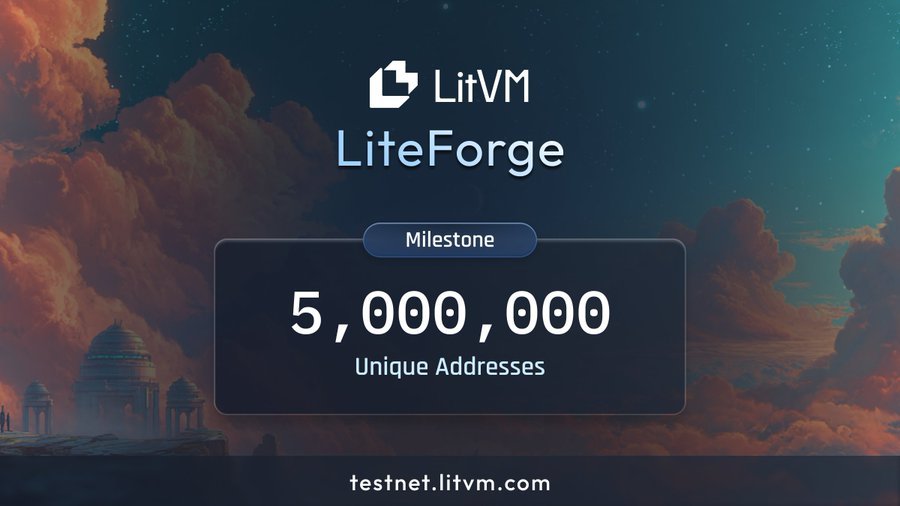
Its LiteForge testnet is live. The testnet launched in April 2026, with more than 50 development teams committed to building decentralized applications on the network.
As per latest update shared by LitVM on X, the testnet has surpassed 5 million unique wallets.
LitVM has also been selected for CMC Labs, CoinMarketCap’s Web3 accelerator program, which is intended to support ecosystem growth and developer adoption before mainnet.
LitVM also lists many applications being built on the testnet across DeFi, NFT, Social, Gaming, RWA, and AI.
That means LitVM is not yet competing on the same hard metrics as mature networks.
Its current traction is better understood as developer commitment, testnet activity and ecosystem positioning, rather than proven mainnet liquidity.
Against competitors, LitVM is early.
Rootstock, one of the oldest Bitcoin smart-contract networks, has more than $100 million in DeFi TVL and about $806,000 in 24-hour DEX volume, according to DefiLlama.
Merlin Chain shows only about $7.6 million in DeFi TVL, but around $740 million in bridged TVL.
Stacks has also built a broader Bitcoin application ecosystem, with its Q1 2026 update citing more than 400,000 wallets and $75.9 million in TVL for Zest Protocol.
So LitVM has tough competition ahead.
But, its advantage is different. It is focused on Litecoin, a network with a long operating history and a large holder base, but much less smart-contract activity than Bitcoin Layer-2s or Ethereum rollups. The opportunity is to unlock dormant LTC liquidity rather than compete as another general-purpose chain from zero.
That is why this investment fits the next phase of crypto treasury companies.
The Crypto Treasury Model Is Evolving
The original corporate crypto treasury model was defined by Michael Saylor’s Strategy, which turned Bitcoin accumulation into a public-equity trade. But as more firms copied that approach, investors began asking whether a treasury company can create value beyond token accumulation.
Some newer treasury firms are answering that question by putting assets to work.
SOL Strategies, a publicly traded Solana-focused company, is one example. The company operates validator infrastructure, stakes SOL and reported 9,171 SOL in staking and validation revenue for the quarter ended March 31, 2026. It also said assets under delegation grew to 3.8 million SOL, while serving more than 34,000 unique wallets across its validator network
DeFi Development Corp. has taken a similar approach.
It is the first U.S. public company with a treasury strategy built to accumulate and compound Solana. It says it actively participates in the Solana ecosystem by holding and staking SOL, while also operating its own validator infrastructure to generate staking rewards and fees from delegated stake.
Forward Industries has also positioned its Solana treasury as an operating strategy, not just a holding strategy.
The company raised $1.65 billion through a private placement led by Galaxy Digital, Jump Crypto and Multicoin Capital to initiate a Solana treasury strategy.
Forward Industries believes that an institutional-scale treasury can be deployed within the Solana ecosystem to generate value faster than simply being a passive holder.
Forward’s public positioning goes even further.
The company’s mission statement is to expand and strengthen the Solana ecosystem by acquiring and staking SOL, providing tools, and investing in the Solana protocol, Solana developers and Solana-based projects. Its treasury flywheel includes staking, lending and DeFi participation as revenue-generating tools.
Ethereum treasury companies are also pushing the “productive asset” argument.
SharpLink became the world’s second largest publicly-traded ETH holder as of March 6, 2026.
Its 2026 objectives include generating yield above native staking rates, expanding partnerships in the Ethereum ecosystem and building a shareholder-aligned ETH treasury company.
That is different from a pure buy-and-hold model because staking helps secure Ethereum while producing on-chain rewards.
The Ether Machine has used similar language.
Its co-founder Andrew Keys told Bloomberg Technology that the company is “not a buy-and-hold treasury,” but an institutional vehicle actively managing Ether to generate risk-adjusted returns.
That reflects why ETH treasuries are being marketed differently from Bitcoin treasuries: Ethereum can be staked and used across stablecoins, tokenization and DeFi.
Even Bitcoin treasury companies are adding ecosystem layers.
Metaplanet, Japan’s Bitcoin treasury company, says one of its goals is to educate and advocate for Bitcoin adoption in Japan. It also holds the exclusive license for Bitcoin Magazine in Japan, using media and education as part of a broader Bitcoin-focused business strategy.
These examples show the same direction.
Crypto treasury companies are trying to prove they can do more than accumulate coins. They are looking for yield, validators, infrastructure, media, developer ecosystems, tokenized securities, DeFi integrations and governance influence.
That shift is partly defensive.
The digital asset treasury market has become crowded. Reuters reported that the number of publicly traded digital asset treasury companies had risen sharply, with many relying on private placements to buy tokens. The same report noted investor concerns around dilution, volatility and firms trading below the value of their crypto holdings.
In that environment, passive holding may not be enough.
A company that only buys tokens can trade at a discount if investors believe they can buy the same asset directly. A company that can generate yield, build infrastructure or increase network usage may have a stronger argument for why it deserves a public-market premium.
Lite Strategy’s LitVM investment should be read through that lens.
The $1 million investment is small in absolute terms. But symbolically, it turns Lite Strategy from a Litecoin treasury holder into a participant in Litecoin’s infrastructure buildout.
What’s next for LitVM
LitVM still has to launch mainnet, convert testnet builders into live applications, attract liquidity and prove that users want DeFi, RWA and AI applications on Litecoin. It also faces competition from Bitcoin Layer-2s, Ethereum rollups, Solana and other high-speed smart-contract networks that already have deeper liquidity.
But the strategy is clear.
Lite Strategy is betting that Litecoin’s next chapter will not be driven only by scarcity or payments. It will be driven by whether Litecoin can become useful inside a programmable financial system.
That is the bigger story for crypto treasuries.
The sector is moving from “buy and hold” toward “hold and build.” Lite Strategy’s investment in LitVM is one of the clearest examples of that shift in the Litecoin market.
Reporting by Rakhi Shah; Editing by Rohit Kumar
More From BlockFirms
Disclaimer: All content published by BlockFirms is intended strictly for informational, educational, and journalistic purposes. Nothing on this platform constitutes financial, investment, legal, technical, or software development advice. Cryptocurrency, decentralized protocols, and blockchain technologies are highly volatile, speculative, and carry inherent risks, including code vulnerabilities, smart contract exploits, and regulatory changes. You risk losing all invested capital. The views expressed by external experts or developers do not reflect the institutional opinions of BlockFirms. We accept no liability for any financial losses or technical damages resulting from reliance on our content. Readers are entirely responsible for conducting independent due diligence and consulting with qualified professionals in their respective jurisdictions. Our Editorial Policy has been updated.