



Michael Saylor’s Strategy has returned to buying Bitcoin, easing some concerns that its recent sale marked a shift away from its long-running accumulation strategy.
The company acquired 1,550 BTC for about $101 million, taking its total Bitcoin reserve to 845,256 BTC. Strategy also increased its U.S. dollar reserve by $100 million to $1 billion.
Saylor posted on X: “Strategy has acquired 1,550 BTC for $101 million to increase our $BTC Reserve to ₿845,256. We have also increased our USD Reserve by $100 million to $1.0 billion.”
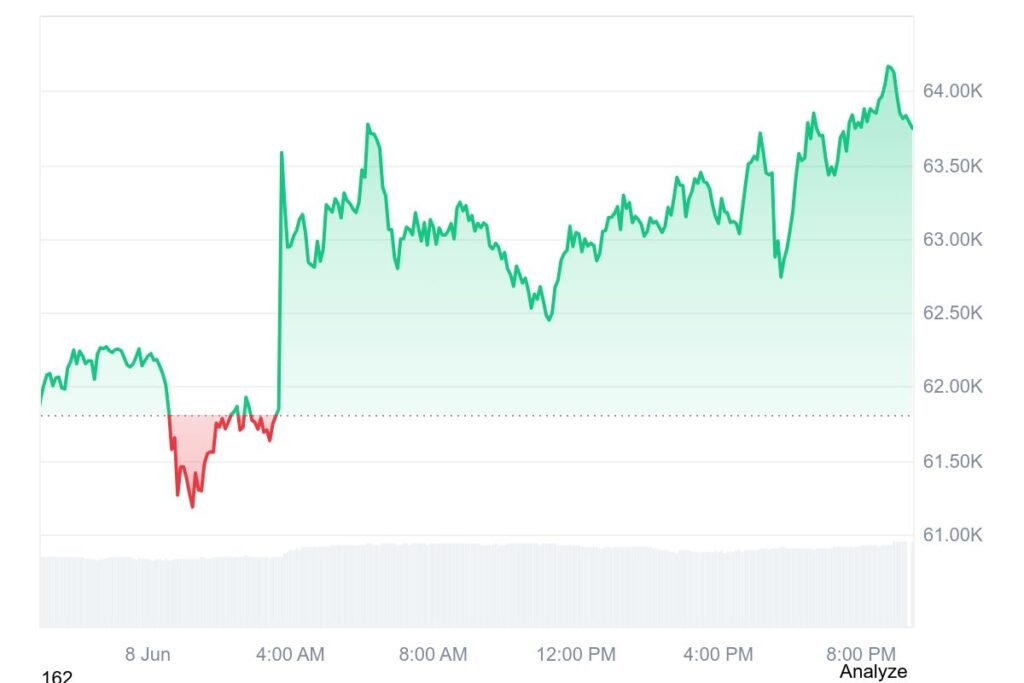
The purchase came as Bitcoin rebounded from a sharp selloff.
Bitcoin was trading at $63,748 at the time of writing, up 2.81% over the past 24 hours. BTC touched an intraday high of $64,120 and a low of $61,185, while 24-hour trading volume rose about 23% to roughly $37.96 billion, according to CoinMarketCap market data. CoinMarketCap showed Bitcoin market cap of $1.27 trillion and 24-hour trading volume of about $37.89 billion.
The latest acquisition is important because it follows Strategy’s first disclosed standalone Bitcoin sale.
The company sold 32 BTC between May 26 and May 31 for about $2.5 million, at an average net price of $77,135 per Bitcoin. The proceeds were intended to fund distributions on its STRC perpetual preferred stock.
That sale triggered debate across the market.
For years, Strategy’s public identity has been tied to one simple message: buy Bitcoin and hold it. Any sale by the largest public corporate holder of Bitcoin was therefore treated by some traders as a possible change in direction.
The latest purchase suggests a more technical reading.
Strategy’s sale represented only about 0.0038% of its holdings at the time, according to CoinDesk’s reading of the company’s filing. The company still held more than 843,700 BTC as of May 31, before the latest purchase lifted the reserve to 845,256 BTC.
That is why the sale and the latest buy should not be read as contradictory signals.
The sale was not a broad liquidation. It was a small treasury operation linked to preferred stock dividend obligations. The new purchase shows that Strategy continues to use capital markets to expand its Bitcoin balance sheet when management sees the transaction as accretive.
Strategy raised $181 million through common stock sales during the latest period, using proceeds to fund the Bitcoin purchase and increase cash reserves to $1 billion. The latest Bitcoin acquisition was made at an average price of $65,332 per coin, below Strategy’s overall average acquisition price of $75,680.
A small sale to meet corporate financing obligations is different from a strategic unwind of Bitcoin exposure. The market may still debate Strategy’s leverage, preferred stock structure and dependence on capital markets, but the latest buy weakens the argument that Saylor’s company has abandoned its Bitcoin accumulation model.
Still, Bitcoin’s broader market setup remains fragile.
The rebound came after Bitcoin briefly traded below $60,000 last week. Bitcoin fell around 15% during the previous week before recovering above $62,000.
The recovery appears to have been driven by a mix of short covering, dip buying and relief after an oversold move.
But the macro backdrop remains difficult.
A 10x Research note argued that the recent Bitcoin selloff was driven less by Strategy’s small sale and more by institutional selling through spot Bitcoin exchange-traded funds after hotter U.S. inflation data. U.S.-listed Bitcoin ETFs saw about $5.4 billion in net redemptions since the April CPI report on May 12, according to the same report.
That flow picture is central to the market.
Bitcoin’s institutional era has changed the asset’s trading structure. ETF flows, inflation expectations, real yields and dollar liquidity now play a larger role in short-term price action than crypto-native narratives alone.
That does not mean Saylor is irrelevant.
Strategy remains one of the most visible corporate Bitcoin buyers in the market. Its purchases can influence sentiment, especially during periods of stress. But the company is no longer the only institutional channel affecting Bitcoin’s price.
ETF redemptions can offset corporate buying.
According to the 10x Research analysis, Strategy accumulated about $2 billion worth of Bitcoin during the same period when U.S. spot Bitcoin ETFs recorded heavy outflows. That suggests that even large corporate buying can struggle to absorb broad institutional selling when macro conditions deteriorate.
The next major test is inflation.
If inflation remains sticky, traders may reduce expectations for Federal Reserve rate cuts. Higher-for-longer rates usually weigh on speculative assets, including Bitcoin, because they raise the opportunity cost of holding non-yielding assets.
That explains why Bitcoin’s rebound is being treated cautiously.
The price action shows demand near the $60,000 zone. But a sustained move higher may require stronger ETF inflows, calmer macro data and reduced geopolitical risk.
Geopolitics is also adding pressure.
Renewed tensions between Iran and Israel have pushed oil markets higher and revived concerns over global inflation. Reuters reported that oil prices rose after renewed hostilities, with Brent and WTI gaining as markets weighed risks around the Strait of Hormuz, a key waterway for global energy flows.
The Strait of Hormuz remains a major concern for macro traders.
Reuters also reported that the European Union imposed sanctions on Iranian individuals and an IRGC Navy unit over actions threatening maritime traffic in the Strait of Hormuz, through which about 20% of the world’s oil supply passes.
The channel is indirect but important for Bitcoin.
Higher oil prices can feed into inflation expectations. Higher inflation can reduce the probability of monetary easing. Lower rate-cut expectations can reduce risk appetite across equities, crypto and other speculative markets.
That is the main tension in Bitcoin today.
On one side, Strategy’s purchase reinforces the long-term corporate treasury narrative. It shows that Saylor’s company remains a buyer after a brief and limited sale. On the other side, Bitcoin is still trading like a macro-sensitive asset.
The asset remains down sharply from its October 2025 all-time high near $126,198, according to CoinMarketCap data. At current levels near $64,000, Bitcoin is still roughly 49% below that peak.
That gap shows how far sentiment has reset.
The market is no longer pricing Bitcoin as a one-way institutional adoption trade. It is pricing a more complex environment marked by ETF outflows, inflation uncertainty, geopolitical shocks and pressure on liquidity.
Strategy’s latest purchase may help stabilize sentiment.
But it does not remove the larger questions.
Can ETF flows turn positive again? Can Bitcoin hold the $60,000 area as support? Will inflation data allow the Federal Reserve to soften its stance? And will Middle East tensions ease before oil prices create a larger macro shock?
The answer is mixed.
Bitcoin’s 24-hour rebound shows that buyers are still active after deep drawdowns. Strategy’s latest purchase also signals continued corporate demand from the market’s most prominent Bitcoin treasury company.
But traders should avoid reading the move in isolation.
The recent 32 BTC sale does not appear to signal a retreat from Bitcoin. The 1,550 BTC purchase does not by itself guarantee a sustained market reversal either.
The more balanced interpretation is that Strategy is managing both sides of its balance sheet.
It is holding and adding Bitcoin.
It is also building cash reserves to meet financing obligations tied to its preferred stock structure.
That distinction is worth noting.
The latest buy reduces fears of a Strategy-led selloff. But the next phase of Bitcoin’s move will likely depend less on Saylor’s purchases and more on ETF flows, inflation data, oil prices and whether geopolitical risk continues to push global markets into a defensive posture.
More From BlockFirms
Disclaimer: This article is for informational purposes only and does not constitute investment advice. Read our Editorial Policy. Parts of this article were drafted/ researched with the assistance of AI tools and subsequently reviewed, edited, and verified by the author and our editorial team to ensure accuracy and journalistic integrity. The final version reflects human editorial judgment and fact-checking. Read our AI Policy.