



Bitcoin’s latest slide is becoming a test of whether the crypto market is still trading on its own fundamentals — or simply acting as another high-beta expression of macro risk.
Bitcoin price briefly fell below $73,000, touching an intraday low near $72,640, before trading around $73,471, as per CoinMarketCap. Ether also slipped below $2,000 during the session, hitting an intraday low near $1,971 before recovering slightly above that level.
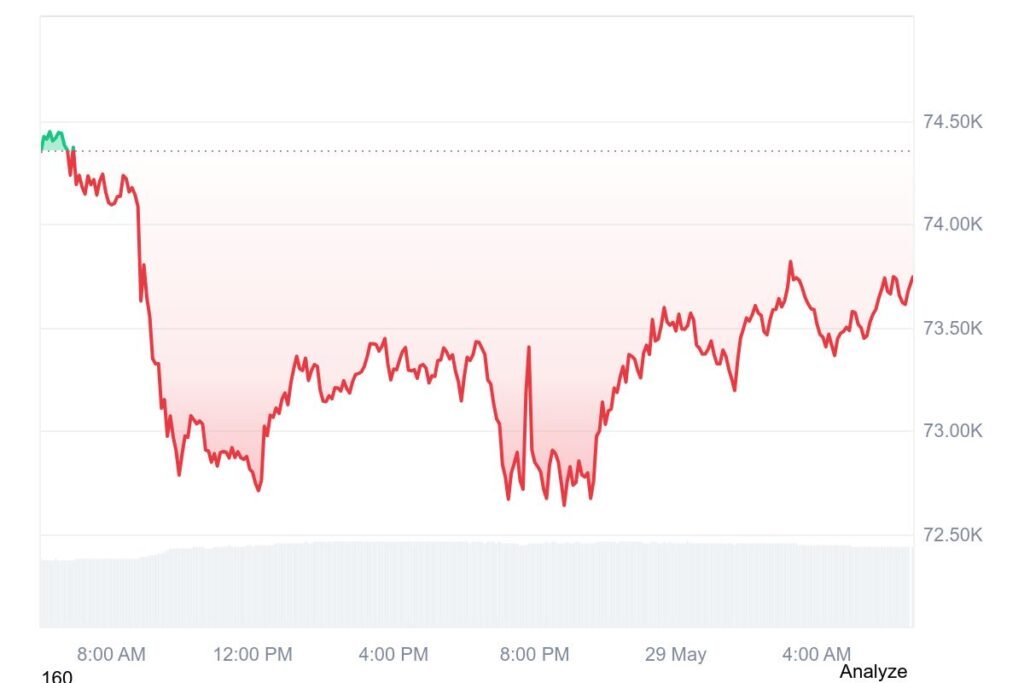
The broader crypto market lost roughly $100 billion in value over 24 hours, with total capitalization falling about 4% to $2.45 trillion. The selling was broad-based, hitting Bitcoin, Ether, Solana, XRP, Dogecoin and smaller tokens.
The move pushed sentiment deeper into caution.
CoinMarketCap’s Crypto Fear & Greed Index dropped to 33, a “fear” reading that showed investors were becoming less willing to absorb volatility after several weeks of ETF outflows and macro pressure.
A market note shared with BlockFirms described the move as “primarily driven by beta-driven selling with U.S. equities,” adding that crypto showed a 61% correlation with the S&P 500, indicating a shared macro-driven move.
That analysis is noteworthy. Bitcoin’s selloff did not appear to follow a single crypto-native shock. Instead, it reflected a combination of rates-sensitive selling, geopolitical risk, weak ETF flows and forced liquidations in leveraged derivatives markets.
The immediate pressure came from the Middle East.
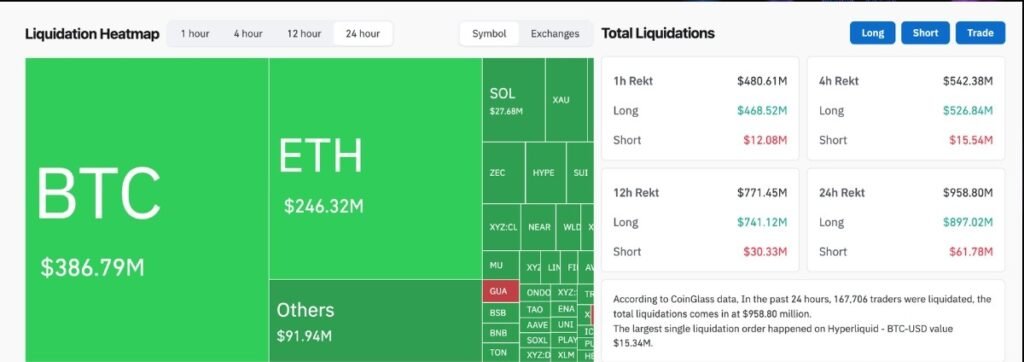
Bitcoin fell below $73,000 after fresh U.S. strikes on Iran revived risk-off trading across crypto and other speculative assets. $1 billion in leveraged crypto positions were liquidated over 24 hours, with long positions making up 93% of the wipeout.
That liquidation profile suggests traders were positioned for stabilization.
When the market moved the other way, forced selling accelerated the decline. Bitcoin liquidations led the wipeout, followed by Ether, according to CoinGlass data.
Geopolitics added another layer.
The latest U.S.-Iran tensions came after markets had partly priced in hopes of a ceasefire extension. AP reported that U.S. and Iranian negotiators had reached a tentative 60-day agreement to extend a ceasefire and begin nuclear talks, pending President Donald Trump’s approval.
That uncertainty kept crypto exposed.
Bitcoin has often been marketed as a hedge against sovereign instability. In practice, it continues to behave like a liquid risk asset during fast macro shocks. When oil, rates and equities react to geopolitical escalation, crypto often follows the same de-risking pattern.
ETF flows intensified the move.
U.S. spot Bitcoin ETFs have seen persistent outflows in recent sessions, removing one of the key sources of marginal demand that helped support Bitcoin earlier this year. Crypto ETF outflows exceeded $2.5 billion over two weeks, while more than $1 billion exited Bitcoin ETFs such as BlackRock’s IBIT over two days.
That huge because ETF demand has become a market-structure variable.
When flows are positive, ETFs can absorb selling and create steady spot demand. When flows turn negative, they can reinforce weakness by forcing underlying Bitcoin sales or reducing the perception of institutional support.
The absence of a large corporate buyer also weighed on sentiment.
Strategy, the company formerly known as MicroStrategy, has not continued its recent pace of Bitcoin purchases despite price slump. Strategy’s ability to fund acquisitions has been linked to preferred and common stock issuance, which has become less attractive as related securities weakened.
That left the market more dependent on natural buyers.
In thinner liquidity, selling pressure can travel faster across majors and altcoins. Ether’s break below $2,000 was particularly important because it showed that the pullback was not limited to Bitcoin or ETF-specific positioning.
The damage spread into higher-beta sectors.
Altcoins linked to real-world assets, meme tokens and unlock-heavy narratives came under pressure as traders cut risk. Token unlocks, including in names such as Pudgy Penguins, added supply-side concerns in parts of the market already facing weak liquidity.
The result was a familiar pattern.
Bitcoin moved first, Ether followed, and smaller tokens amplified the downside. That sequence has become more common as institutional products concentrate liquidity in Bitcoin while retail-heavy sectors remain more vulnerable to sharp drawdowns.
The policy backdrop is more constructive, but not immediately supportive.
The CLARITY Act, the major U.S. crypto market-structure bill, advanced out of the Senate Banking Committee on May 14 by a 15-9 vote and now moves toward the Senate floor. The bill aims to clarify when digital assets fall under securities, commodities or other regulatory frameworks.
For crypto markets, that is a long-term positive.
Clearer rules could reduce enforcement uncertainty, make institutional participation easier and define how exchanges, brokers and token issuers operate in the U.S. The bill would clarify regulators’ jurisdiction over the sector, a central demand of the crypto industry.
But the legislation is not yet law.
Reuters reported that some Democrats who voted to advance the bill may not support it on the Senate floor without further changes. Concerns remain over anti-money-laundering provisions, stablecoin rewards and political conflicts of interest.
Those details matter for market pricing.
The Senate version includes provisions on stablecoin rewards, anti-money-laundering obligations, fundraising exemptions, decentralized finance and tokenization. It would place digital commodity exchanges, brokers and dealers under Bank Secrecy Act obligations, while also clarifying that tokenized securities remain subject to securities laws.
That makes CLARITY important but not a near-term rescue.
Policy optimism can support valuations over time. It cannot immediately offset ETF redemptions, leveraged liquidations or geopolitical risk.
Trump’s latest crypto-related social-media intervention also added to the policy narrative.
In a Truth Social post, Trump said: “where we are currently the Crypto (Bitcoin, etc.) Capital of the World, other Countries are trying diligently to replace us in that capacity, but we won’t let that happen. It is a major Industry, and we must protect it.”
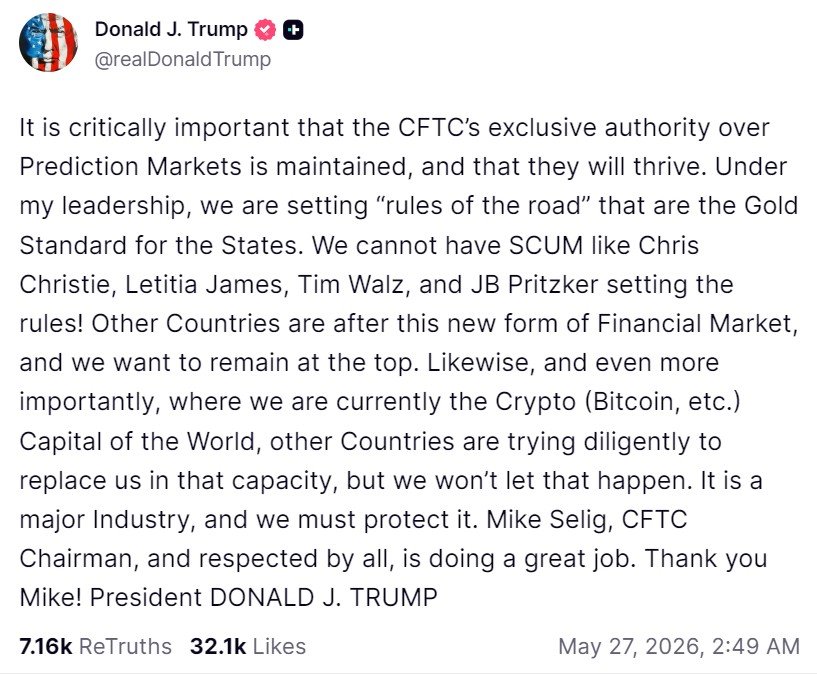
The statement reinforces the administration’s pro-crypto posture.
But it also comes as federal and state authorities clash over prediction markets, crypto oversight and the role of the Commodity Futures Trading Commission. Trump’s support for federal CFTC authority over prediction markets has become part of a broader regulatory fight.
This is sending a mixed message to traders.
A pro-crypto White House and advancing market-structure bill are supportive for long-term adoption. Yet the same political environment also carries headline risk, especially when Middle East policy, oil prices and interest-rate expectations are moving markets.
The near-term technical picture is now centered on $72,000–$73,000.
If Bitcoin holds that zone and ETF outflows slow, the market could stabilize. A recovery above $76,000 would suggest that the latest flush was largely liquidation-driven rather than the start of a deeper repricing.
A break lower would change the setup.
Below $72,000, traders are likely to watch the $70,000 level as the next major psychological support. A clean loss of that level could trigger another round of systematic selling and push weaker altcoins into sharper declines.
The bigger question is whether Bitcoin can regain independence from macro assets.
For now, the evidence points the other way. ETF products, corporate balance-sheet buyers and institutional liquidity have tied Bitcoin more closely to traditional risk appetite, even as crypto policy in Washington becomes more favorable.
That is the contradiction defining the market.
Crypto has more institutional infrastructure than in prior cycles. It also has more exposure to the same shocks that move equities, rates and oil.
The current selloff is another stress test for Bitcoin bulls.
More From BlockFirms
Disclaimer: This article is for informational purposes only and does not constitute investment advice. Read our Editorial Policy. Parts of this article were drafted/ researched with the assistance of AI tools and subsequently reviewed, edited, and verified by the author and our editorial team to ensure accuracy and journalistic integrity. The final version reflects human editorial judgment and fact-checking. Read our AI Policy.