



In Brief
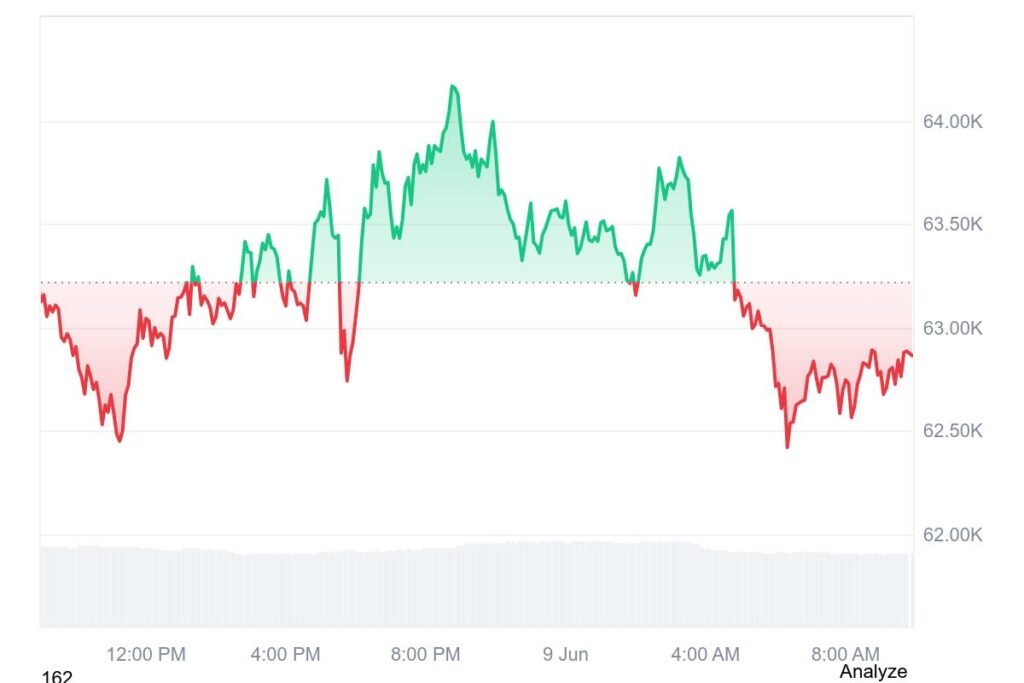
- Bitcoin slipped 0.05% to $62,832, after it recovered from the last week slump below $60K to above $64K.
- Strategy’s recent 32 BTC sale raised concerns among traders because of its long-held “never sell” image.
- Strategy quickly returned to buying – added 1,550 BTC, lifting its total Bitcoin reserve to 845,256 BTC.
- The episode shows that large Bitcoin holders may become more tactical, managing dividends, liabilities and cash buffers while continuing long-term accumulation.
Bitcoin is struggling to find direction.
As per CoinMarketCap, Bitcoin was down 0.05% over the past 24 hours to $62,832 at the time of writing, moving almost in line with a flat broader crypto market. Bitcoin traded between an intraday high of $64,166 and a low of $62,450, while 24-hour trading volume fell 6.51% to $33.71 billion.
The overall crypto market also showed little momentum.
Total market capitalization slipped 0.25% to $2.16 trillion, reflecting a market caught between bargain hunting near support levels and caution over macroeconomic risk, geopolitical tension and institutional flows.
At the center of the latest debate is Strategy.
The company, led by Executive Chairman Michael Saylor, recently sold 32 Bitcoin, its first disclosed sale since 2022. The transaction was small in size but large in symbolism because Strategy has long been viewed as the corporate face of Bitcoin accumulation.
According to a CoinDesk report on Strategy’s late-May filing, the company sold 32 BTC between May 26 and May 31 for about $2.5 million, at an average net price of $77,135 per coin.
The sale was used to help cover dividend obligations on its STRC perpetual preferred stock.
That distinction matters.
The transaction was not presented as a market call on Bitcoin or a loss of conviction in the asset. It was a balance-sheet operation linked to the company’s financing structure.
Strategy still held more than 843,000 BTC after the sale.
The disposal represented roughly 0.004% of its Bitcoin treasury, making it immaterial from a holdings perspective. Yet the market reaction was not immaterial.
Bitcoin weakened from the $77,000 range toward the $60,000 zone, while Strategy’s shares also came under pressure.
The sale challenged a long-running narrative that Saylor’s company would never sell Bitcoin under any circumstance. That narrative had always been more powerful than the numbers.
The sale did not suggest Strategy was exiting Bitcoin.
It showed that the company is now willing to use a small part of its treasury to manage obligations tied to the capital structure it has built around Bitcoin accumulation.
That is a different message.
Strategy’s model has evolved from a simple corporate treasury bet into a complex financing machine. It raises capital through equity and preferred instruments, uses proceeds to buy Bitcoin, and then manages obligations to investors who fund that structure.
The 32 BTC sale should be understood in that context.
If Strategy had issued more shares to fund a small dividend payment, it may have created dilution. If it had sold more preferred stock under unfavorable conditions, it may have raised capital inefficiently.
Selling a tiny amount of Bitcoin at a price above its average acquisition cost was one way to meet the obligation without materially changing the treasury position.
That is why traders should not confuse the sale with capitulation.
The clearest evidence came almost immediately. After selling 32 BTC, Strategy returned to buying.
On June 8, Strategy said it had acquired 1,550 BTC for about $101 million, at an average price near $65,300. The purchase lifted its total Bitcoin reserve to 845,256 BTC.
The company also increased its cash reserves by $100 million to $1 billion after the purchase.
That cash buffer is important.
It signals that Strategy is trying to reduce pressure around future preferred dividend payments and avoid the perception that Bitcoin sales are the default funding mechanism.
In other words, the company sold a negligible amount, then bought far more.
The net effect was accumulation, not distribution.
That is why the latest buy should help separate accounting mechanics from market direction. Strategy’s stated objective remains increasing net Bitcoin holdings and Bitcoin per share over time.
CEO Phong Le reinforced that point on X on June 7, writing: “Our corporate @Strategy is to increase net Bitcoin and Bitcoin per share over time. Rumors otherwise are just rumors.”
Saylor’s own messaging also remained consistent.
His June 7 post, which showed the company’s Bitcoin purchase chart, suggested that Strategy remained focused on adding to its long-term position. The next day’s acquisition confirmed that the small sale had not interrupted the broader accumulation strategy.
Still, the episode matters.
Strategy now owns roughly 4% of Bitcoin’s eventual 21 million supply. That makes its actions highly visible and, at times, market moving.
Even a small sale can affect sentiment because traders treat the company as a proxy for institutional conviction.
The issue is not the 32 BTC.
The issue is what the market thinks the 32 BTC means.
Strategy’s renewed purchase supports the argument that large corporate holders remain buyers on weakness. For skeptics, the sale showed that even the most committed Bitcoin treasury company may need to sell coins when its financing structure requires cash.
Both views contain some truth.
Strategy has not abandoned its Bitcoin thesis. But it has also moved beyond a pure “never sell” posture.
The company is now operating like a leveraged public-market vehicle with Bitcoin as its core reserve asset.
That makes the story more mature, but also more complicated.
For traders, the better question is not whether Strategy sold. It is whether the company continues increasing Bitcoin per share without creating excessive dilution or financing stress.
So far, the latest numbers support that objective.
The company sold 32 BTC, bought 1,550 BTC and expanded its cash reserves. That combination suggests the sale was not a directional bearish signal on Bitcoin.
It was a tactical funding decision inside a larger accumulation framework.
The broader Bitcoin market remains fragile, however.
Bitcoin is trading close to the $60,000 support zone, a level watched by technical traders because a decisive break could trigger renewed selling. Market weakness has also been tied to ETF outflows, risk-off positioning and competition for capital from other high-growth assets, including artificial intelligence stocks.
Geopolitics is another pressure point.
Middle East tension has kept investors focused on energy prices, inflation risk and global risk appetite. Reuters reported that oil prices edged higher as investors awaited clarity after an Iran-Israel halt in attacks, with markets still cautious about the durability of the de-escalation.
That’s crucial for Bitcoin because geopolitical shocks can tighten financial conditions indirectly.
If oil prices rise, inflation expectations can firm. If inflation risk rises, rate-cut expectations may weaken. If the dollar strengthens, liquidity-sensitive assets can come under pressure.
Bitcoin has not behaved like a clean safe haven during this period.
Instead, it has traded more like a risk asset. When geopolitical stress lifts oil prices and raises inflation fears, investors often reduce exposure to volatile assets.
That can pressure Bitcoin even when its long-term supporters argue that it should benefit from distrust in fiat systems.
The short-term market is different from the long-term thesis.
Adam Back, the Blockstream CEO and long-time Bitcoin advocate, captured the ideological side of that thesis in a post on X. He wrote that he wants capital from retirement accounts, corporations, sovereign buyers and traditional portfolios to flow into Bitcoin, saying: “Let the old system finance its own replacement. Let Bitcoin eat.”
That view reflects the deeper conviction behind institutional Bitcoin adoption.
But markets do not move only on conviction. They also move on liquidity, leverage, rates, ETF flows, equity sentiment and geopolitical risk.
That is the current tension.
Bitcoin bulls see Strategy’s latest purchase as confirmation that corporate treasury demand remains alive. Bears see the earlier sale, ETF outflows and weak price action as signs that the market is still vulnerable.
The truth is more balanced.
Strategy’s small sale should not be read as a signal that Saylor is turning bearish. The company’s immediate repurchase of a much larger amount points in the opposite direction.
But the episode does show that corporate Bitcoin holders may become more tactical as their capital structures become more complex.
That is not necessarily bad for Bitcoin.
It may mark the next phase of institutional adoption, where companies do not just buy and hold, but also manage reserves, liabilities, dividends and shareholder expectations around Bitcoin.
So, Strategy’s latest activity does not remove downside risk in Bitcoin. It also does not validate panic over a 32 BTC sale.
The more important signals are whether Bitcoin holds the $60,000 region, whether ETF outflows slow, whether geopolitical risk eases and whether corporate buyers continue adding during weakness.
At the moment, Bitcoin remains rangebound and cautious. And, Strategy remains a net buyer.
And the market is still deciding whether corporate Bitcoin treasuries are becoming more disciplined — or more vulnerable to the same liquidity pressures that affect every other financial asset.
More From BlockFirms
Disclaimer: This article is for informational purposes only and does not constitute investment advice. Read our Editorial Policy. Parts of this article were drafted/ researched with the assistance of AI tools and subsequently reviewed, edited, and verified by the author and our editorial team to ensure accuracy and journalistic integrity. The final version reflects human editorial judgment and fact-checking. Read our AI Policy.