


In brief
- Over 400,000 BTC have moved off exchanges in past 1 year, around 2% of total supply.
- Exchange balances have dropped to around 2.1–2.7 million BTC, near cycle lows.
- Spot Bitcoin ETFs and public companies now hold more BTC than all centralized exchanges combined, a first in Bitcoin’s history.
Bitcoin is quietly undergoing one of its biggest ownership shifts since the asset’s inception — and it’s happening just as BTC price hover around $90,000 after a bruising autumn drawdown.

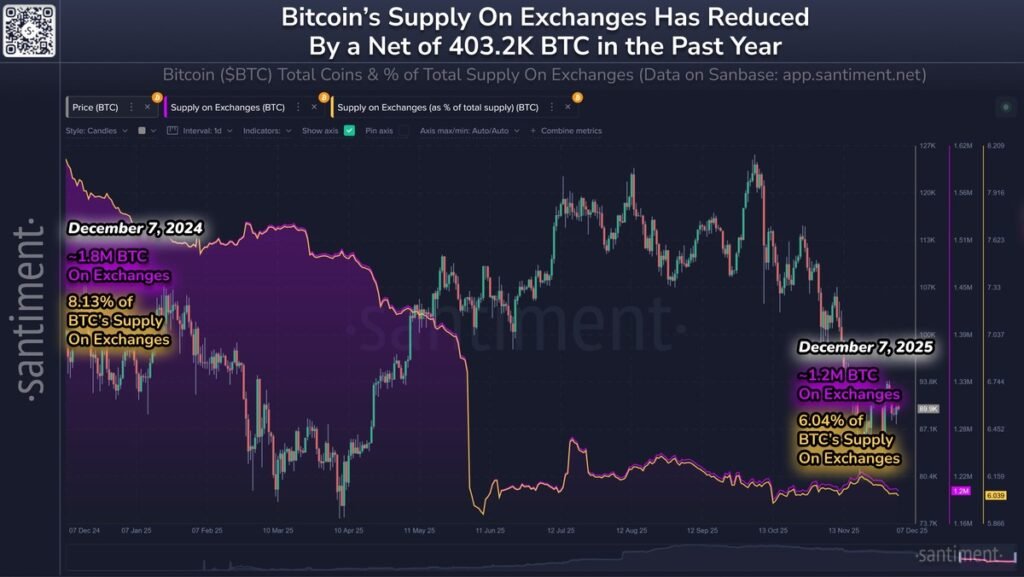
On-chain data shows more than 400,000 Bitcoin — about 2% of the eventual 21 million-coin cap — have left centralized exchanges over the past year, a move largely driven by long-term holders shifting to self-custody and institutional vaults.
At the same time, a new dataset from payments firm River shows that spot exchange-traded funds and publicly listed companies now control more Bitcoin than all centralized trading venues combined. Their combined stacks have climbed from a few hundred thousand coins early last cycle to more than 2 million by late 2024 and around 2.5 million today.
The result: the liquid supply available for immediate sale on exchanges is shrinking just as traditional-finance wrappers put Bitcoin in front of a broader investor base.
Exchange Reserves at Cycle Lows
A recent report using CryptoQuant data estimates that Bitcoin reserves on centralized exchanges have fallen to about 2.76 million BTC, one of the lowest readings on record.
That decline has persisted through this year’s sharp correction from October’s all-time high above $125,000, when Bitcoin briefly traded like a macro darling before giving back more than a quarter of its value.
Crucially, analysts note that balances fell faster during November–December’s sell-off, rather than rising as they typically do when traders rush coins onto exchanges to sell. Instead, investors continued to withdraw BTC into cold storage even as prices slid toward the high-$90,000s.
That pattern suggests the marginal seller is not the long-term holder, but leveraged traders and fast-money funds unwinding positions in futures and ETF arbitrage, while structural buyers keep absorbing supply.
ETFs and Treasuries Now Dominate the Float
According to the River dataset cited by CryptoDnes, the combined reserves of spot Bitcoin ETFs and publicly traded companies have now overtaken the total BTC held on centralized exchanges — a first in Bitcoin’s history.
U.S. spot ETFs alone account for roughly 4.6% of total supply, while listed corporates, led by Michael Saylor’s Strategy, hold hundreds of thousands of coins on their balance sheets.
Recent analysis from the same outlet estimates that roughly one-third of all known Bitcoin holdings are now controlled by ETFs, governments and large corporate treasuries.
A separate breakdown from Phemex, citing Santiment data, puts ETF and public-company holdings at around 2.5 million BTC — more than the coins sitting on exchanges. On-exchanges held a total balance of about 2.11 million BTC in late November.
That flips the market structure that dominated earlier cycles, when exchanges were the primary reservoir of liquid supply and institutions played almost no role.
Supply Squeeze vs. Mixed Demand Signals
In classical commodity logic, a shrinking freely tradable float is bullish: with fewer units available at the margin, a given dollar of new demand can move price further. On-chain analysts have labeled the current setup a “pre-supply-shock” environment. Analysts argue that any sustained demand pickup — for instance, a renewed wave of ETF inflows — could push Bitcoin back toward six-figure territory faster than in previous cycles.
But demand is not one-way.
After blockbuster inflows earlier in the year, U.S. spot Bitcoin ETFs have recently seen choppier flows, including a near-$200 million daily net outflow last week, and more than $2 billion in redemptions over the past several sessions according to Farside-based tallies cited by CryptoDnes.
Standard Chartered has now halved its 2025 year-end Bitcoin price target to $100,000 from $200,000, pointing to softer buying from corporate “Bitcoin-as-a-treasury-asset” firms even as the bank maintained a very bullish long-term view.
At the same time, research house 10x and others have flagged that long-term holders offloaded roughly 400,000 BTC during the October–November drawdown — a rare bout of profit-taking that helped drive the move from record highs to the $80,000s.
Those coins didn’t necessarily remain on exchanges, but the episode shows that even supposedly “locked-up” supply can re-enter the market when prices or macro conditions change.
What It Means for Bitcoin’s Price Path
The current configuration — historically low exchange reserves, rising ETF and treasury ownership, and a price consolidating around $90,000 ahead of a widely expected Federal Reserve rate cut — has several implications.
1. Higher Sensitivity to Flows
- With fewer coins on exchanges, spot prices are likely to become more sensitive to incremental ETF creations or redemptions, as well as to large over-the-counter deals that eventually ripple into exchange order books.
- A renewed period of strong ETF inflows could therefore have an outsized impact compared with prior cycles when exchange balances were closer to 3 million BTC or above.
2. Tighter Liquidity, Sharper Moves
- Reduced float can cut down on “wall of sell orders” overhead, potentially supporting medium-term uptrends.
- The flip side is that when selling does hit — for example, from derivatives liquidations or a sudden macro shock — thinner order books may amplify intraday volatility. Phemex explicitly warns that lower exchange reserves may bring liquidity challenges for new traders even as they reduce constant sell pressure.
3. Growing Institutional Price Power
- As control of Bitcoin migrates from retail-dominated exchanges to ETFs, governments and large corporates, pricing power increasingly sits with entities that move in board-room cycles rather than trading chats.
- That could make Bitcoin more correlated with traditional risk assets and policy expectations — and less with the “crypto-native” flows that drove earlier booms.
4. Structural Bullish Tilt, Cyclical Headwinds
- On-chain metrics that track long-term accumulation and shrinking exchange supply generally align with stronger multi-year performance in past cycles.
- But in the near term, macro uncertainty, ETF outflows and the recent behavior of long-term holders all argue against assuming a straight-line move higher, even with fewer coins on offer.
A “Tight but Not Empty” Market
For now, Bitcoin is trading in the low-$90,000s, down from October’s record yet still modestly positive for the year.
The supply squeeze is real: fewer coins are parked on exchanges, more sit in long-term vaults at ETFs and corporate treasuries, and on-chain data points to a structural decline in readily sellable inventory. But whether that translates into the explosive upside some “supply shock” narratives imply will depend less on what’s left to sell — and more on who still wants to buy, at what price, and under what macro backdrop.
In other words, Bitcoin’s float is getting tighter. Its future price path, however, is still a function of flows.
Disclaimer: This article is for informational purposes only and does not constitute investment advice.
AI Disclaimer: Parts of this article were drafted with the assistance of AI tools and subsequently reviewed, edited, and verified by the author and our editorial team to ensure accuracy and journalistic integrity. The final version reflects human editorial judgment and fact-checking.


