


- BTC’s weekly RSI is at an extreme oversold level (below 30), a signal that has historically appeared near major cyclical bottoms rather than during normal volatility.
- Ethereum and most major altcoins also declined, showing the sell-off is broad-based and not limited to Bitcoin.
Bitcoin slid toward a key support zone on Tuesday, with BTC trading around $63,800 and touching an intraday low near $62,700, as a broader risk-off move across global markets weighed on crypto sentiment. Ethereum also fell, trading near $1,854, while the total crypto market capitalization slipped to about $2.22 trillion, according to CoinMarketCap market data.

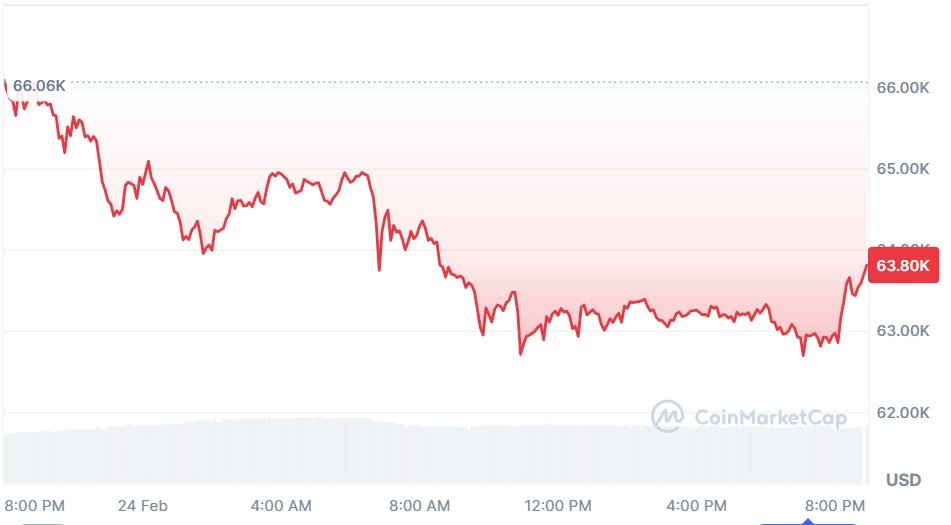
The pullback leaves Bitcoin hovering just above the $60,000 level that many traders see as both a psychological and structural support threshold. Market participants have increasingly framed the zone as a liquidity-heavy inflection point after Bitcoin’s recent retreat from higher February levels. CoinMarketCap historical snapshots show Bitcoin was near $78,689 on Feb. 2 and around $67,659 on Feb. 22, underscoring the speed of the latest downdraft.
Technical analysts are also focusing on momentum signals. Bitcoin’s weekly RSI reached 25.92. A weekly RSI below 30 is an oversold threshold that has historically been associated with late-stage drawdowns rather than the start of fresh, extended selloffs. That does not guarantee a rebound, but it helps explain why some analysts see current price action as an “exhaustion” phase.
What has changed versus prior oversold episodes is the macro backdrop. A renewed round of trade-policy uncertainty linked to President Donald Trump’s tariff push has pressured equities and boosted haven demand, with gold rising as stocks fell. That cross-asset pattern has reinforced crypto’s correlation with risk assets rather than safe havens in the current tape.
The Federal Reserve backdrop has added to the drag. Fed officials have recently emphasized that policy remains restrictive, and Reuters reported the benchmark rate is still in the 3.50%-3.75% range, with inflation concerns and tariff-related uncertainty complicating the path to further easing. That has helped keep risk appetite constrained across speculative assets, including digital tokens.
Flows data point to the same caution. CoinShares’ latest published report (for the week ending Feb. 16) showed a fourth straight week of outflows from digital-asset investment products, and the subsequent CoinShares weekly update said outflows extended to a fifth week at about $288 million, with cumulative redemptions around $4 billion over five weeks. Bitcoin-linked products reportedly led the withdrawals, while short-Bitcoin products saw modest inflows — a sign of defensive positioning.
Derivatives positioning also appears cautious. CoinGlass data show Bitcoin futures open-interest metrics and exchange-level open-interest tracking remain a central focus for traders, and market commentary has described subdued activity and lower participation in crypto ETPs during the selloff.
For now, the near-term setup looks split between technical exhaustion and macro suppression. If Bitcoin holds the low-$60,000 zone, traders may look for a reflex rebound toward the mid-$60,000s. But a decisive weekly break below $60,000 would likely shift focus to deeper downside targets in the mid-$50,000s, especially if tariff-driven volatility and rate uncertainty continue to dominate global risk sentiment.
More From BlockFirms
Disclaimer: This article is for informational purposes only and does not constitute investment advice. Read our Editorial Policy. Parts of this article were drafted/ researched with the assistance of AI tools and subsequently reviewed, edited, and verified by the author and our editorial team to ensure accuracy and journalistic integrity. The final version reflects human editorial judgment and fact-checking. Read our AI Policy.
Image Credits: Canva


