


Bitcoin traded near $62,000 on Wednesday as crypto markets entered a critical macro session shaped by U.S. inflation data, elevated Treasury yields and rising geopolitical tension in the Middle East.
Bitcoin was up about 1% over the past 24 hours to $61,980 at the time of writing. Bitcoin traded between an intraday high of $62,170 and a low of $60,782, while 24-hour trading volume rose 8.56% to $35.25 billion, as per CoinMarketCap data.

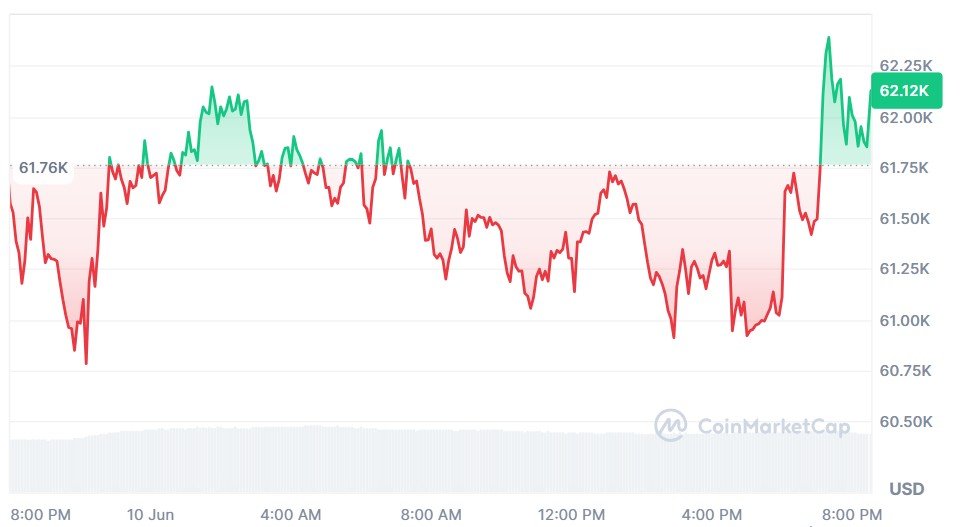
The broader crypto market was also firmer, but only modestly. Total crypto market capitalization rose 0.41% to $2.13 trillion, suggesting that the latest Bitcoin move was not yet a broad risk-on breakout.
The market tone remains cautious.
Bitcoin’s rebound followed a volatile stretch in which traders continued to debate whether the asset is stabilizing near the lower end of its range or preparing for another leg lower. That debate has become more important as macro conditions tighten.
U.S. inflation remains the central market catalyst. Economists polled by Reuters had expected May core CPI to rise 0.3% month-on-month and accelerate to 2.9% year-on-year, compared with 2.8% in the previous month.
For crypto, the signal is mixed.
Inflation that comes in close to expectations may reduce immediate shock risk. But sticky core inflation still limits the market’s ability to price aggressive Federal Reserve rate cuts.
That matters for Bitcoin.
The asset has increasingly traded as a liquidity-sensitive macro instrument, reacting not only to crypto-native flows but also to U.S. yields, the dollar and expectations for Federal Reserve policy.
Ryan Lee, chief analyst at Bitget Research, said markets were approaching the U.S. CPI release with inflation expectations already reflected across major asset classes.
“Markets are approaching today’s U.S. CPI release with inflation expectations already reflected across major asset classes,” Lee said. “The 10-year Treasury yield is holding near 4.54%, the U.S. dollar remains firm around DXY 100, and gold has retreated from recent highs.”
Gold had already fallen to a more than two-month low before the CPI release, pressured by rising Treasury yields and renewed expectations that U.S. rates could remain higher for longer.
Lee said Bitcoin was trading near $61,000-$62,000, while Ether was near $1,625. He also noted that equities had softened after last week’s stronger-than-expected employment report.
The bond market is now the main transmission channel.
The U.S. 10-year Treasury yield has remained elevated after recent labor-market data pushed traders to reassess the path of Federal Reserve policy. Reuters reported this week that yields were mixed after jobs data lifted rate-hike odds and markets turned their attention to CPI.
Higher yields typically raise the opportunity cost of holding non-yielding assets.
For Bitcoin, the impact is not mechanical, but it is important. When yields rise and the dollar strengthens, global liquidity conditions usually become less supportive for crypto.
Lee said a higher-than-expected inflation reading would reinforce current market positioning, supporting yields and the dollar while weighing on liquidity-sensitive assets such as Bitcoin, Ethereum and growth equities.
A softer reading, he added, would challenge recent repricing in rates markets, improve expectations for policy easing and support broader risk sentiment.
“The most important signal following the release may come from the bond market,” Lee said. “Treasury yields have led recent repricing across asset classes, and their direction after the CPI report will provide a clearer indication of whether investors expect inflation pressures to persist or begin moderating.”
That leaves Bitcoin in a narrow tactical zone.
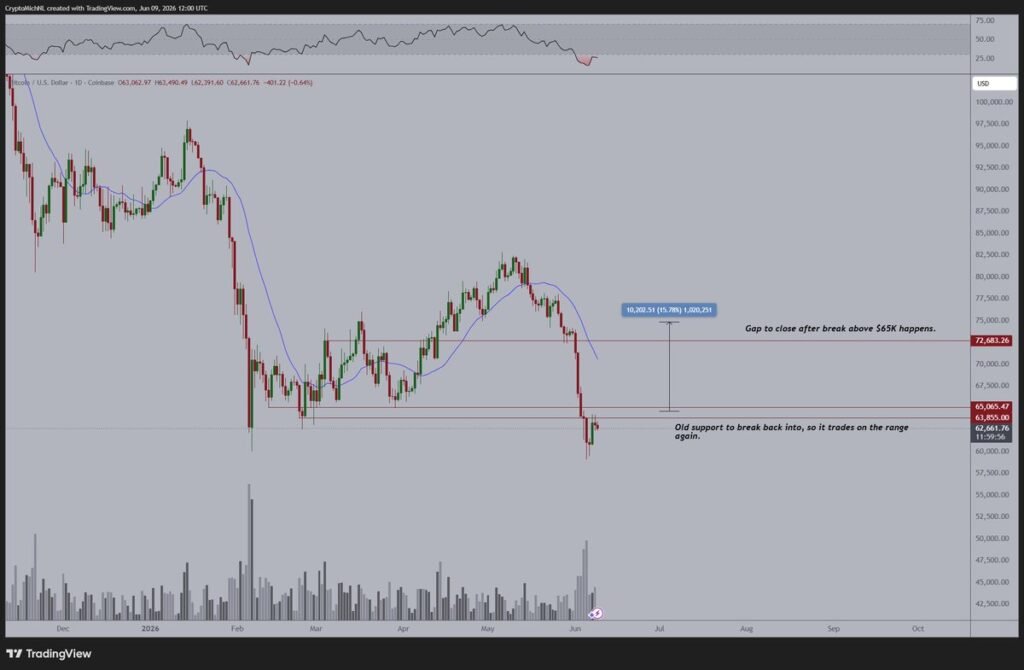
A sustained move above $65,000 could shift sentiment toward a stronger recovery. But failure to regain that level may keep downside risk active, especially if macro pressure continues.
Crypto analyst Michaël van de Poppe, CIO and founder of MN Fund and MN Capital, said Bitcoin remains stalled below a key level.

Michaël van de Poppe X
“Bitcoin is stalling beneath $65K as breaking that level would trigger a strong run to $72-74K,” van de Poppe wrote on X.
He said $65,000 had previously acted as support after the February crash and is now operating as resistance.
“If it happens for Bitcoin’s price to stance, I think that we’ll be able to run fast towards the other side of the range, namely $72-74K,” he said.
Van de Poppe described the recent selloff as “relatively irrational,” adding that he did not think it would take long before markets attempted a recovery.
That view reflects the bullish case.
Bitcoin is close enough to a major resistance level that a clean reclaim could force short covering and momentum flows. In that scenario, traders may quickly rotate from defensive positioning into a range-reclaim trade.
But technical analysts are not aligned.
Rekt Capital warned that Bitcoin’s market structure has deteriorated after losing a long-term moving average level.

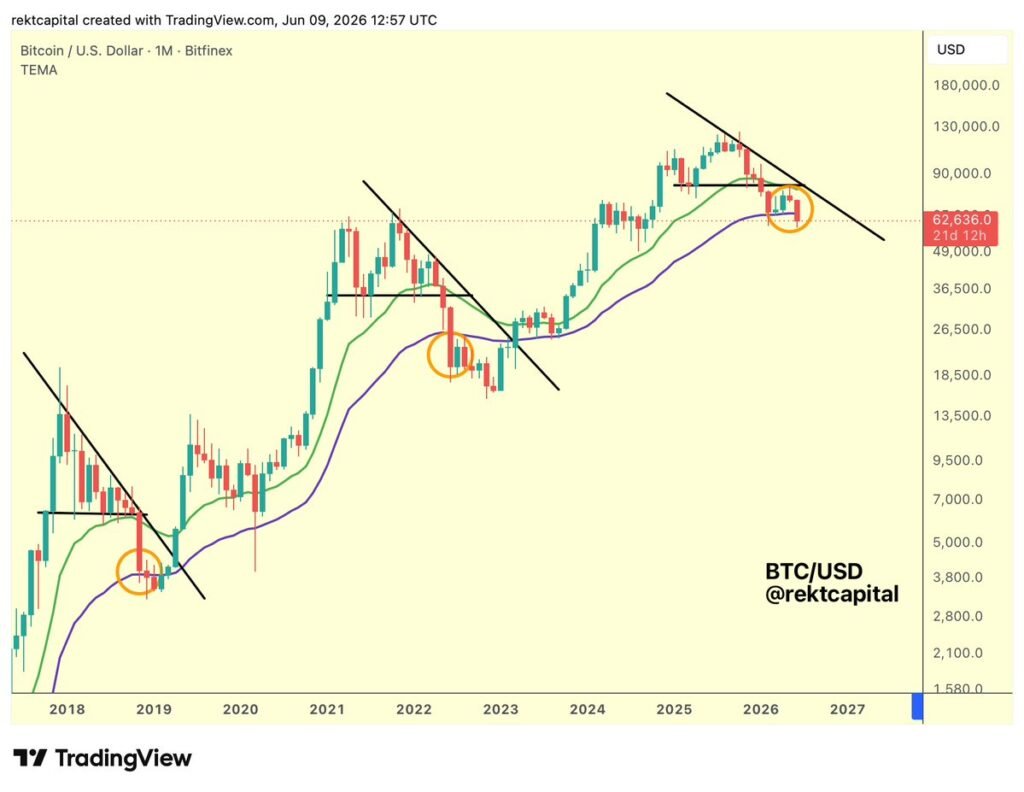
“It has happened, Bitcoin rejected from the Macro Triangle base and has lost the 50-Month EMA as support,” Rekt Capital wrote on X. “Now Bitcoin needs to fully confirm this breakdown to enter additional Bearish Acceleration to the downside.”
That warning places the current market at a technical inflection point.
If Bitcoin fails to reclaim lost support levels, the bounce toward $62,000 may be treated as a relief move rather than the start of a durable reversal.
The 50-month exponential moving average is widely tracked by long-horizon technical traders. Losing it does not automatically confirm a bear-market continuation, but it can change positioning among systematic and trend-following participants.
That makes confirmation important.
A daily or weekly close below key support zones could deepen bearish momentum. A rapid reclaim, however, could invalidate the breakdown and trap late sellers.
The CPI report adds another layer.
Consensus expectations for May CPI already showed investors were preparing for persistent inflation pressure. Reuters reported that core CPI was expected to accelerate on an annual basis to 2.9%, keeping the Federal Reserve in a difficult position as markets debated whether policy easing could resume soon.
The Fed is therefore unlikely to be pushed quickly toward easing unless inflation data weakens more convincingly.
That keeps crypto exposed to a “higher for longer” rates environment, where rallies need stronger spot demand or clearer policy support to continue.
Geopolitics is now part of the macro trade.
Oil prices rose Wednesday after renewed U.S.-Iran tensions and fresh threats from U.S. President Donald Trump raised concerns about supply risk. Brent crude climbed as investors reacted to renewed war risk and potential disruptions linked to the Strait of Hormuz.
Global markets also weakened as geopolitical risk intensified. World shares fell and oil rose after renewed Iran-U.S. strikes, with investors also focused on U.S. inflation data due later in the day.
That is a difficult mix for Bitcoin.
In past cycles, Bitcoin has sometimes benefited from geopolitical stress as a hedge against sovereign risk. But in the current market, the dominant short-term reaction has often been liquidity-driven.
When war risk pushes oil higher, inflation expectations can rise. When inflation expectations rise, yields can remain elevated. When yields remain elevated, crypto often struggles to attract fresh risk capital.
This is why the CPI print and geopolitical backdrop are linked.
A softer core CPI reading may calm markets temporarily. But if oil continues rising because of Middle East conflict, traders may worry that inflation pressure will return in future data.
That reduces the market’s willingness to price quick Fed easing.
Bitcoin is therefore trading between two narratives.
The first is the recovery narrative. It says the recent selloff went too far, macro expectations are already priced in and a break above $65,000 could quickly open the way toward $72,000-$74,000.
The second is the breakdown narrative. It says Bitcoin has lost important long-term support, liquidity remains tight and elevated yields could trigger another phase of downside if buyers fail to reclaim key levels.
For now, neither side has full control.
Bitcoin’s 1% gain shows that buyers are defending the low-$60,000 area. But the modest gain in total crypto market value suggests there is still limited conviction beyond short-term trading.
Ether’s weakness near $1,625 also signals that risk appetite across the broader crypto complex remains fragile.
Altcoins typically need stronger Bitcoin stability and improved liquidity expectations to outperform. Without that, rallies can remain concentrated in Bitcoin and quickly fade.
The next test is market reaction after CPI.
If Treasury yields remain stable or decline, Bitcoin could attempt another push toward $65,000. That would bring van de Poppe’s breakout scenario into focus.
If yields rise again, the pressure may return quickly.
That would strengthen Rekt Capital’s warning that Bitcoin needs to avoid confirming a deeper technical breakdown.
For institutional traders, the key issue is no longer only Bitcoin’s spot price. It is whether macro conditions allow the asset to rebuild trend strength.
A flat crypto market, firm dollar, elevated yields and geopolitical uncertainty do not create an easy backdrop.
Still, Bitcoin has not broken decisively lower.
The market is waiting for confirmation.
A move above $65,000 would suggest the latest selloff has exhausted itself. A failure to reclaim that area, combined with rising yields or further geopolitical escalation, could leave Bitcoin vulnerable to another downside move.
For now, Bitcoin remains caught between macro relief and technical caution.
That tension is likely to define the next phase of trading.
More From BlockFirms
Disclaimer: This article is for informational purposes only and does not constitute investment advice. Read our Editorial Policy. Parts of this article were drafted/ researched with the assistance of AI tools and subsequently reviewed, edited, and verified by the author and our editorial team to ensure accuracy and journalistic integrity. The final version reflects human editorial judgment and fact-checking. Read our AI Policy.


