

Zcash was built on a promise that few crypto projects can credibly make.
Privacy, backed by advanced cryptography.
That promise was shaken last week after developers disclosed a critical flaw in Zcash’s Orchard shielded pool, the privacy system that allows users to send transactions without exposing sender, recipient or amount.
The vulnerability was discovered on May 29, 2026, by independent security researcher Taylor Hornby during security work commissioned by Shielded Labs.
According to a Zcash Community Forum post, Hornby used Anthropic’s Opus 4.8 model as part of a targeted review of the Orchard circuit and built a working exploit in a local test environment. The exploit generated unlimited, mathematically valid but counterfeit ZEC.
The flaw had been present since Orchard was activated in May 2022.
That means a bug capable of breaking Zcash’s supply integrity survived almost four years of review, upgrades and ecosystem scrutiny. It was fixed through an emergency remediation deployed on June 1, according to Shielded Labs.
The market reacted fast.
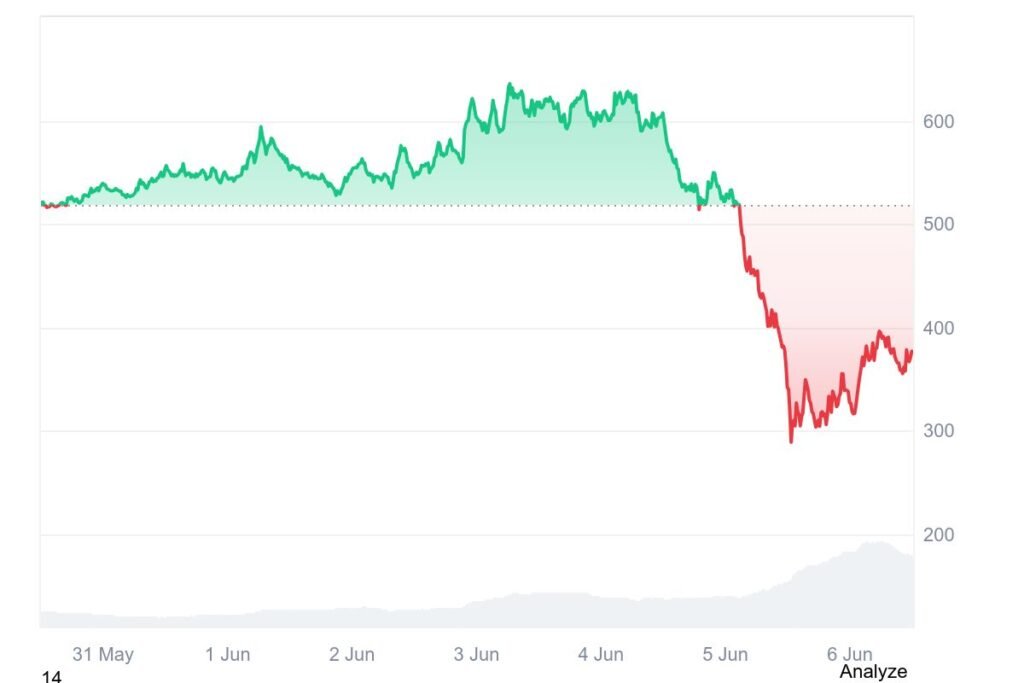
ZEC dropped sharply after the disclosure, plunging almost 50% to $289 from weekly high of $635. It recovered slightly after Zcash confirmed that it has patched the critical flaw in the Orchard shielded pool. At the time of writing ZEC was trading near $376.59 on June 6, down 27% over seven days, with $3.18 billion in 24-hour trading volume as investors repriced the risk.

The incident has become more than another crypto bug story.
It is now a test case for two questions facing digital assets in the AI era.
Can artificial intelligence make crypto systems more secure?
And can it do so before attackers use the same tools first?
A Privacy Coin’s Worst Kind of Bug
Zcash is not a typical token project.
It is one of the oldest privacy-focused cryptocurrencies and claims itself as “encrypted electronic cash,” using zero-knowledge encryption for private P2P payments. The protocol allows shielded transactions, where details are hidden while validity is still cryptographically verified.
That design is powerful.
It is also unforgiving.
In a transparent blockchain, analysts can usually inspect flows, trace suspicious balances and detect some forms of abnormal issuance. In a shielded system, the privacy layer deliberately limits what outsiders can see.
That becomes a problem when the bug affects the rules that prove supply integrity.
Shielded Labs said the vulnerability involved an under-constrained element in the Orchard circuit. In plain terms, the circuit allowed false inputs to pass a check that should have rejected them. That made it possible to create counterfeit ZEC inside the shielded pool while still producing proofs that appeared valid.
The most damaging part is not only that the bug existed.
It is that nobody can now prove, using cryptography alone, that it was never exploited before the fix.
Shielded Labs said prior exploitation appears unlikely, citing the sophistication required, the years of scrutiny the bug survived and the speed of remediation once it was discovered. But it also said users should not rely on trust in that assessment. The group is exploring a network upgrade that would create a new shielded pool and use “turnstile accounting” to let anyone verify Zcash’s supply integrity.
The bug may have been fixed. However, the doubt it created may take longer to repair.
Why AI Changed the Story
Security researchers have used automation for decades.
Static analyzers, fuzzers, symbolic execution engines and formal methods are all part of modern software security. Smart contract auditors also routinely combine manual review with automated checks. OpenZeppelin, for example, says its audit process includes line-by-line manual review, static analysis and fuzz testing, with at least two auditors assigned to the same codebase.
But the Zcash case is different because a frontier AI model appears to have helped find and operationalize a bug that human experts missed for years.
According to Shielded Labs, Hornby began evaluating Zcash with “AI-assisted security auditing techniques” alongside traditional research methods. Shortly after Anthropic released Opus 4.8 on May 28, he used it in a highly targeted review of the Orchard circuit and discovered the vulnerability the next day.
This does not mean the AI acted alone.
The human researcher chose the target, built the workflow, interpreted the result and responsibly disclosed the issue. The model was part of a security apparatus, not an independent auditor.
Still, the result is significant.
AI lowered the cost of deep reasoning over complex code and helped convert a theoretical flaw into a working proof of concept.
That is exactly why the event is being watched beyond crypto.
Anthropic announced earlier his week that it was expanding Project Glasswing, a cybersecurity initiative using its Claude Mythos Preview model, from about 50 organizations to roughly 200 partners. Anthropic said participants had identified more than 10,000 highly or critically severe security flaws, while also warning that similarly powerful models may become broadly available within 6 to 12 months.
That makes Zcash a live example of the same dynamic.
AI can help defenders find hidden flaws.
It can also help attackers do the same.
Can AI Make Crypto More Trustable?
The answer is yes, but only in a narrow and conditional sense.
AI can improve crypto security if it is used as part of a disciplined assurance stack. That means pairing frontier models with expert auditors, reproducible test harnesses, formal verification, fuzzing, bug bounties and transparent disclosure processes.
It does not mean replacing cryptographers with chatbots.
Crypto is unusually exposed to software failure because code often controls money directly. A bug in a traditional app may leak data or disrupt service. A bug in a blockchain protocol can mint money, drain a bridge, freeze assets or break consensus.
AI can help by expanding search capacity.
It can review large codebases faster, compare implementations against specifications, generate test cases, search for invariant violations and assist exploit construction in controlled environments. For under-resourced open-source projects, that could be a major improvement.
But trust in crypto does not come from finding one bug.
It comes from proving that the system’s critical rules are correct, observable and enforceable over time.
The Zcash episode shows both sides.
AI helped find a catastrophic flaw before public exploitation was known. That is positive.
But the flaw still existed for four years in a system whose value proposition rests on cryptographic assurance. That is negative.
The result is not “AI makes crypto safe.”
The better conclusion is that AI changes the security baseline. Projects that do not use advanced AI-assisted review may increasingly be at a disadvantage against researchers and attackers who do.
The New Security Arms Race
The wider cybersecurity world is already moving in this direction.
Anthropic’s Project Glasswing is being rolled out to governments and critical infrastructure partners under access controls. The company said the effort is designed to harden software before these capabilities become more widely available.
Crypto faces an even sharper version of that problem.
Most major blockchains are open source. Their code, cryptographic circuits and smart contracts are available for anyone to inspect. That openness is central to trust, but it also gives AI agents a large attack surface to analyze.
Recent research on AI agents for smart contract security points to the same risk.
The EVMbench paper found that stronger agents and better scaffolding can materially change performance, and that exploit capability is especially consequential because successful exploits can translate directly into transferable value. The authors also cautioned that their benchmark was curated and should not be read as representative of all live blockchain bugs.
That caution is important.
AI security tools are not magic vulnerability oracles. They produce false positives, miss context and can fail on protocol-specific assumptions. They also perform better when given strong harnesses, specifications and human direction.
The Zcash case reinforces that point.
Hornby’s result appears to have depended not only on Opus 4.8, but also on a targeted review and specialist expertise. A general prompt thrown at a codebase is not the same as an audit.
Similar Efforts and What They Show
The closest parallel is not one specific crypto project using AI.
It is the broader shift from one-off audits to continuous, tool-assisted security.
OpenZeppelin’s audit model shows the traditional institutional approach: multiple human reviewers, manual code inspection, static analysis, fuzzing and structured fix review. That process is designed to catch business-logic and edge-case failures that generic tools miss.
Trail of Bits and other security firms have also pushed deeper tooling around blockchain assessments, including vulnerability analysis, economic risk assessment, bridge validation and off-chain component review.
The broader lesson is that crypto security is no longer just about checking Solidity functions. It increasingly requires full-system review across cryptography, economics, governance, bridges and operational assumptions.
AI may strengthen those workflows.
It may help auditors test more assumptions, generate more adversarial cases and revisit old code with new methods. But the result still depends on process quality.
A badly scoped AI audit can create false confidence.
A well-scoped AI-assisted audit can uncover bugs humans missed.
The Zcash disclosure is the clearest example so far of the second case.
Why This Matters Beyond ZEC
The immediate damage is to Zcash’s credibility. But the deeper issue is sector-wide.
Crypto markets often treat code as law. But code is written by humans, reviewed by humans and increasingly attacked by machines. The more complex the system, the more dangerous that assumption becomes.
Privacy protocols, zero-knowledge systems and cross-chain bridges are especially exposed because their security properties are hard for ordinary users to verify. Even sophisticated investors often rely on reputational trust: founders, auditors, foundations, security firms and community review.
The Zcash bug weakens that trust model.
It shows that a protocol can be respected, technically advanced and heavily scrutinized, yet still contain a flaw that threatens monetary integrity.
AI can help close that gap. But it also raises the minimum standard for what responsible development looks like.
Projects may now be expected to run AI-assisted reviews before launch, after upgrades and during ongoing maintenance. They may also need stronger formal verification for critical circuits, larger bug bounties and clearer emergency governance.
Shielded Labs said it is initiating a project to formally verify the Orchard circuit and plans to deepen proactive security research using state-of-the-art AI tools.
That may become the industry template. Not because AI guarantees safety. Because not using it may soon look negligent.
The Bottom Line
The Zcash incident is not a simple win for AI. It is a warning.
A frontier model helped a skilled researcher find a bug that could have allowed unlimited counterfeit ZEC. That is a powerful defensive milestone. It likely reduced the chance of future damage.
But the same tools are becoming more available, more capable and more useful for exploit development.
The trust equation is changing in crypto.
Security will no longer be judged only by whether a project was audited before launch. It will be judged by whether its defenses can keep pace with AI-assisted attackers after launch.
Zcash may have been lucky that the bug was found by a white-hat researcher.
The next protocol may not be.
More From BlockFirms
Disclaimer: This article is for informational purposes only and does not constitute investment advice. Read our Editorial Policy. Parts of this article were drafted/ researched with the assistance of AI tools and subsequently reviewed, edited, and verified by the author and our editorial team to ensure accuracy and journalistic integrity. The final version reflects human editorial judgment and fact-checking. Read our AI Policy.


