


In Brief
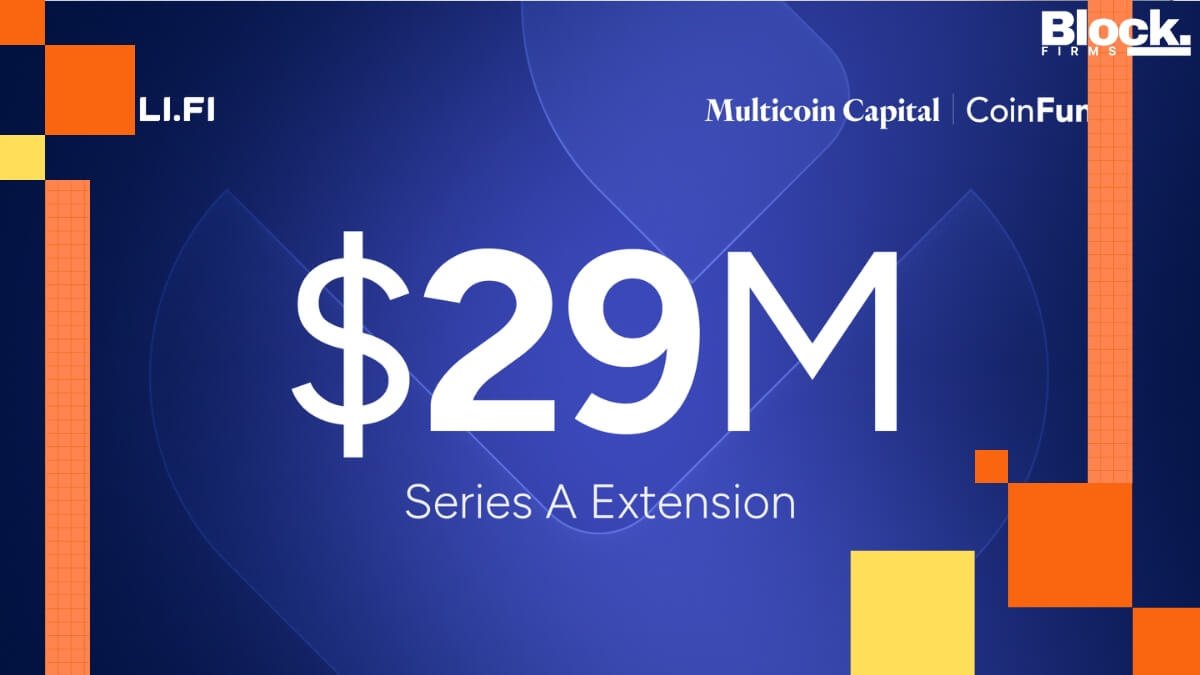
- LI.FI raised a $29 million Series A extension, led by Multicoin Capital and CoinFund, bringing total funding to $51.7 million.
- Funding will support new product development, including infrastructure for AI agents and stablecoins.
LI.FI Protocol, a developer-focused liquidity and interoperability platform, has raised a $29 million Series A extension led by Multicoin Capital and CoinFund, bringing its total funding to $51.7 million. The round comes as crypto developers increasingly seek unified infrastructure to support trading and asset movement across a growing number of blockchains.
The company, which has scaled to more than 100 employees globally, is nearing 1,000 B2B integrations with clients including Robinhood, Binance, Kraken, MetaMask, Phantom, Ledger and Circle. Monthly transaction volume routed through LI.FI jumped nearly sixfold over the past year — rising from $1.15 billion in October 2024 to $8 billion in October 2025 — as fintechs and Web3 applications embed multi-chain functionality directly into user-facing products.
Founded in 2021, LI.FI has emerged as one of the largest interoperability toolkits powering crypto trading inside mainstream apps. Its infrastructure aggregates bridges and decentralized exchanges, allowing developers to access cross-chain liquidity through a single API. The company recently surpassed $60 billion in lifetime transaction volume.
Tackling Fragmentation Across the Crypto Stack
The new capital will fund the next phase of LI.FI’s product expansion, including infrastructure for AI agents and stablecoins, and the launch of an open intent and solver marketplace in early 2026 aimed at broadening liquidity sourcing for enterprise customers.
The investment comes as the crypto ecosystem becomes increasingly fragmented, with activity spreading across multiple layer-1 and layer-2 networks. That fragmentation has created both performance and reliability challenges for developers offering real-time swaps and cross-chain transfers.
“Crypto adoption is rapidly increasing just as the blockchain infrastructure underneath fragments and proliferates,” said David Pakman, managing partner at CoinFund. “LI.FI is a universal layer that solves this fragmentation problem, allowing for true global cross-chain liquidity and asset interoperability.”
Multicoin’s Spencer Applebaum said LI.FI is emerging as critical infrastructure for fintech apps integrating crypto. “The hardest problem is no longer user demand — it’s making fragmented blockchains, liquidity, and execution work seamlessly together,” he said.
Growing Institutional and Developer Demand
LI.FI’s customer roster reflects a shift in how exchanges, wallets and fintech platforms are approaching interoperability. Instead of building routing, bridging and execution logic internally, many are opting for outsourced infrastructure that can abstract complexity while maintaining self-custody for end users.
Chief Executive Philipp Zentner said the company has broadened its product suite over the past year to reduce friction for partners integrating multi-chain swaps. “This growth allows LI.FI to continue laying the foundation for the next generation of crypto applications,” he said. “Our goal remains to make composability invisible and reliable.”
The protocol’s roadmap includes expanding its solver networks and liquidity access — a move that could reinforce its positioning as core middleware for both consumer and institutional crypto applications.
With new funding and accelerating adoption, LI.FI is preparing for increased demand from developers seeking to unify liquidity and on-chain execution across an increasingly complex Web3 landscape.
Disclaimer: This article is for informational purposes only and does not constitute investment advice.
AI Disclaimer: Parts of this article were drafted with the assistance of AI tools and subsequently reviewed, edited, and verified by the author and our editorial team to ensure accuracy and journalistic integrity. The final version reflects human editorial judgment and fact-checking.