



Bitcoin extended its November slide on Monday, briefly slipping under the crucial $86,000 level and deepening one of its sharpest pullbacks since 2022, as forced liquidations, macro jitters and thinning liquidity hit risk assets again.
According to CoinMarketCap Bitcoin price data, BTC fell around 5.4% over the past 24 hours, dropping from intraday levels near $91,965 to $85,630. That move erased more than $200 billion from Bitcoin’s market capitalization, taking prices down roughly 22% for November and leaving the asset about 11% lower year-to-date.
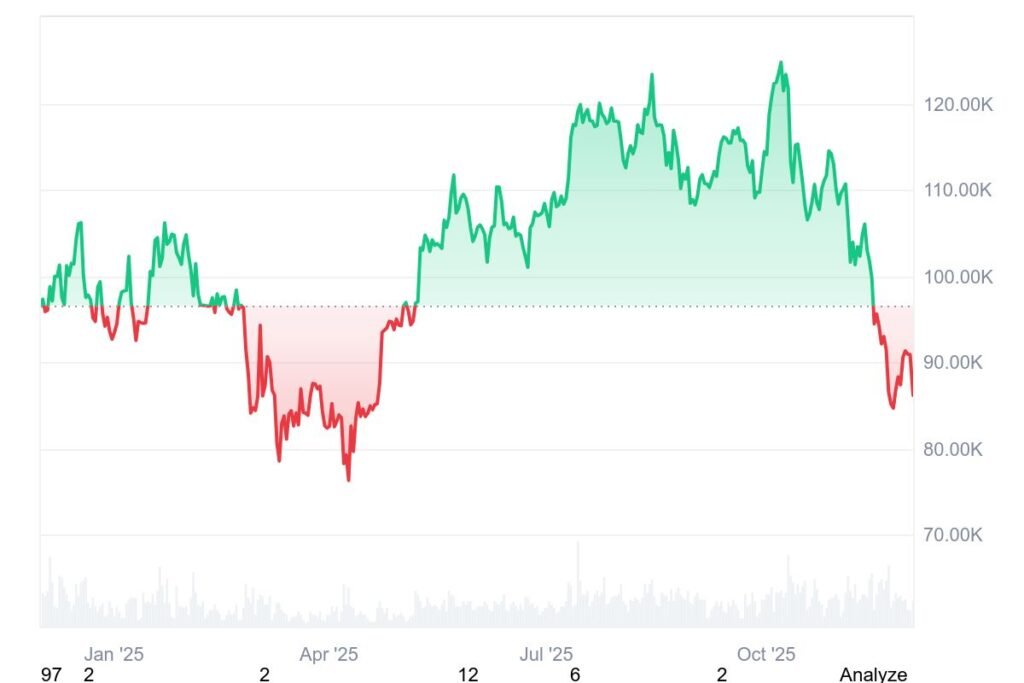
At the time of writing, Bitcoin trades near $86,000, hovering close to seven-month lows and testing a support area that several analysts have highlighted as critical for the short term.
What triggered the latest leg lower
The latest drop comes after another wave of liquidations washed through derivatives markets during early Asia trading. Data tracked by CoinDesk show more than $500 million in bullish crypto bets were wiped out in hours, with Bitcoin losing over 5% while Ether slid more than 6%.
Traders pointed to several overlapping drivers behind the move:
Thin order books and high leverage: After weeks of choppy price action, liquidity has thinned out. That makes the market vulnerable to large orders and cascading liquidations when prices break key levels.
Risk-off macro mood: Global markets are bracing for heavy economic data and fresh signals on U.S. rates. Asian equities traded mixed as the yen strengthened on comments from Bank of Japan governor Kazuo Ueda, reinforcing a cautious tone across risk assets.
Broader crypto deleveraging: November’s slide has already erased more than $1.2 trillion from total crypto market value, pushing many leveraged traders to the sidelines and forcing liquidations across altcoins.
Market commentators say the latest flush looks like a continuation of the same regime that dominated November: weak ETF flows, rate uncertainty, and investors de-risking from speculative assets after a parabolic run earlier this year.
November turns “red” despite being Bitcoin’s strongest month on paper
The timing of the sell-off has unsettled traders because November is usually Bitcoin’s best month historically. Data from CoinGlass show that, from 2013 to 2025, November has delivered the highest average monthly return, with mean gains around 40–42% and a median near 8–9%.
This year broke that pattern. Multiple datasets now show November 2025 as one of Bitcoin’s worst months since the Terra/Luna-FTX crisis in 2022, with losses in the 20–25% range.
Some traders have claimed that “red Novembers” — months when Bitcoin closes lower in November — are often followed by strong rebounds in January, sometimes averaging around 15%. However, available historical data paint a more nuanced picture.
Analyses of Bitcoin’s calendar returns suggest that January’s long-term average gain is closer to low single digits, around 4%, and far below the typical November surge.
The historical sample is also small and extremely volatile, making any precise “15% bounce” claim more of a trading meme than a statistically robust rule. In other words, seasonality may offer context, but it does not guarantee a sharp January recovery.
MicroStrategy keeps buying into the dip
Against the backdrop of heavy selling, some long-term institutional players have continued accumulating.
Strategy — the enterprise software company formerly known as MicroStrategy and now effectively a leveraged Bitcoin proxy — disclosed on November 17 that it had purchased 8,178 BTC for around $835.6 million, at an average price near $102,000.
As per their disclosure, Strategy added smaller tranches earlier in the month, taking its total November purchases to 9,062 BTC for roughly $931 million. At current prices, those November coins are down about 11%, underscoring how quickly paper profits can disappear in Bitcoin’s drawdowns.
Even so, the firm now holds roughly 649,870 BTC, acquired over several years at a blended cost that remains below current spot levels.
For bulls, the continued accumulation by Strategy and other long-horizon investors is a sign that large players still view the asset as a strategic reserve. Critics counter that concentrated corporate holdings and aggressive leverage may amplify volatility when markets turn lower.
What analysts are watching next
Opinion is split on whether the current zone near $86,000 marks a tradable bottom or just a pause before deeper losses.
Research firm K33 has previously flagged the $84,000–$86,000 band as a potential local support area, noting that prior capitulation events often stabilized in similar percentage drawdown zones.
Other analysts are less optimistic. A recent report highlighted three downside risks that could push BTC towards $50,000: slowing ETF inflows, a weaker macro backdrop, and fading retail participation.
From today’s levels, traders are broadly watching three key zones:
Immediate support:
The recent low around $85,000–$86,000, where long liquidations intensified.
Below that, the psychologically important $80,000 round number.
Overhead resistance:
Short-term resistance sits in the $92,000–$95,000 range, where BTC repeatedly failed in late November.
More optimistic targets cluster around $100,000, cited by some technical strategists who see scope for a rebound if macro conditions stabilize and ETF flows recover.
Macro triggers:
Upcoming U.S. inflation prints and Federal Reserve commentary, which could reshape expectations for 2026 rate cuts.
Ongoing headlines around Trump-era tariffs, AI-related equity volatility and broader risk sentiment, all of which have weighed on Bitcoin this year.
Several desks now describe the market as being in a “reflexive zone”, where positioning and liquidity may matter more than fundamentals over the next few weeks. That environment tends to reward nimble traders rather than passive dip-buyers.
Elon Musk doubles down on Bitcoin as an “energy-based” currency
While prices slid, Bitcoin’s narrative continued to feature prominently in the news cycle.
In a recent interview with Indian entrepreneur Nikhil Kamath, Tesla and SpaceX CEO Elon Musk described Bitcoin as a “physics-based” form of money. “Energy is the true currency. This is why I said Bitcoin is based on energy,” Musk said, arguing that governments cannot legislate their way into abundant energy and that BTC’s value is ultimately tied to the cost of securing its network.
The comments sparked fresh debate over Bitcoin’s energy footprint and its positioning as a long-term “digital commodity” rather than a short-term trading instrument, even as the market grapples with a steep drawdown.
Pain now, but cycle debate continues
For now, the data are clear: Bitcoin’s November correction has pushed it back into negative territory for 2025, despite starting the year above $110,000 and posting new all-time highs in the spring.
Whether this proves to be a mid-cycle reset or the start of a deeper bear phase will likely depend on:
How quickly derivatives positioning cleans up.
Whether spot ETF outflows stabilize.
The trajectory of global rates and risk appetite into early 2026.
Bitcoin has often rebounded strongly from similar drawdowns, however, those rebounds can take months to materialize — and rarely follow a clear seasonal trend.
Disclaimer: This article is for informational purposes only and does not constitute investment advice.
AI Disclaimer: Parts of this article were drafted with the assistance of AI tools and subsequently reviewed, edited, and verified by the author and our editorial team to ensure accuracy and journalistic integrity. The final version reflects human editorial judgment and fact-checking.