


In Brief
- Macron is scheduled to become the first sitting G7 leader to address an institutional digital-assets conference.
- The speech points to euro stablecoins, the digital euro and regulation as strategic European priorities.
- France is positioning itself as a leading regulated hub for digital finance under MiCA.
French President Emmanuel Macron is set to give Paris Blockchain Week a level of political validation the digital-asset industry has rarely received from a major Western leader.
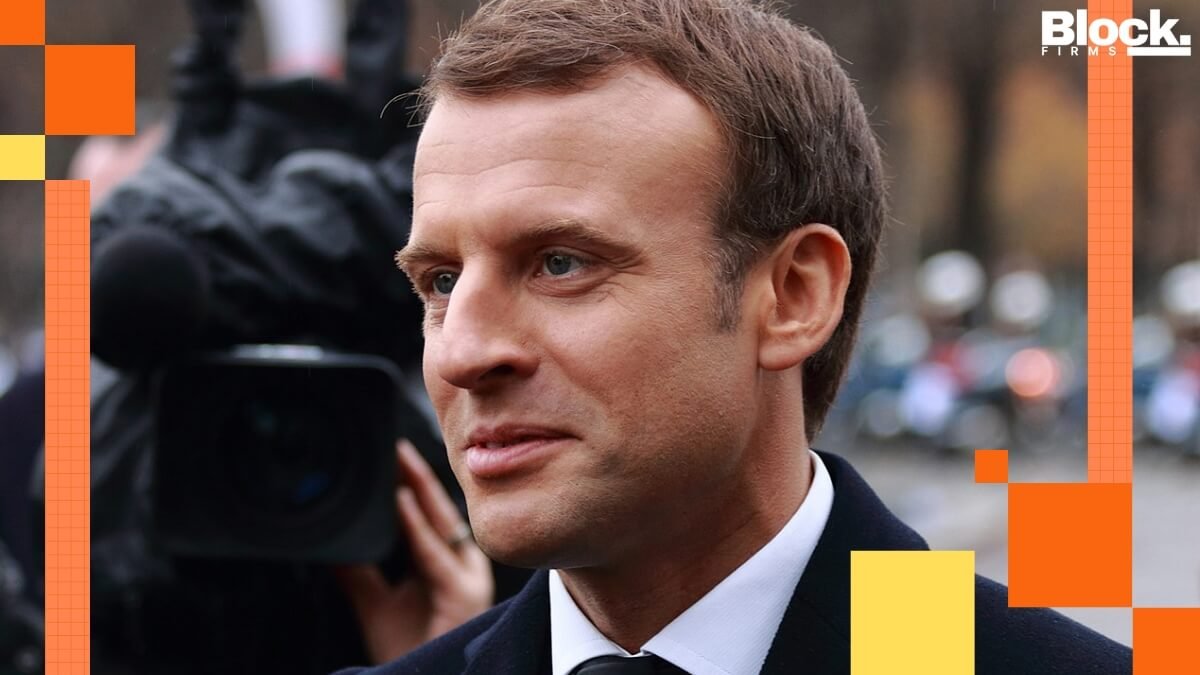
Macron will deliver a special address at the April 15-16 conference in Paris, according to the details BlockFirms received from the organizers. This is the first instance that a sitting G7 head of state would be speaking at an institutional conference focused on digital assets. His remarks will center on euro-denominated stablecoins, the digital euro and Europe’s regulatory position in digital finance.
That matters beyond conference optics.
It suggests France is trying to push digital assets further into the European policy mainstream, at a moment when Brussels, Frankfurt and national capitals are increasingly treating payments, settlement infrastructure and currency reach as strategic issues rather than niche fintech debates. Recent ECB and European policy signals have moved in the same direction, tying digital payments and tokenized finance more explicitly to Europe’s “strategic autonomy” and the international role of the euro.
Macron’s own language has already framed the issue in geopolitical terms.
“Europe should also seek to strengthen the international role of the euro through the development of euro stablecoins and the introduction of a digital euro, as well as the creation of safe and liquid assets to finance defence and technology,” he wrote in a Financial Times opinion piece in December. That line, repeated in the Paris Blockchain Week announcement, places digital money inside a wider agenda that links capital markets, industrial policy and security.
The immediate conclusion is not that France is “embracing crypto” in the broad retail sense.
The more credible reading is narrower and more institutional. Paris appears to be signaling that regulated digital-asset infrastructure now belongs in the conversation about European financial sovereignty. In that framing, euro stablecoins and a potential digital euro are not only payment tools. They are also instruments that could help Europe reduce dependence on dollar-based rails, deepen euro liquidity in digital markets and keep more financial innovation inside the bloc’s own legal perimeter.
France has some standing to make that case.
Its PACTE law created an earlier national framework for digital-asset businesses, and the AMF has been managing the transition from the French DASP regime toward the EU-wide MiCA rulebook. MiCA entered into force in June 2023, with provisions for stablecoin issuers becoming applicable from June 30, 2024 and most crypto-asset service rules applying from December 30, 2024. France’s regulator has said it has been adapting its doctrine to help firms move from the old domestic system into the new European one.
That makes Macron’s appearance more than ceremonial.
It amounts to a public endorsement of the idea that the next phase of digital-asset policy in Europe will be shaped by banks, market infrastructure, regulators and sovereign institutions, not just crypto-native startups. Paris Blockchain Week says this year’s event will host executives and officials tied to BNP Paribas, Crédit Agricole, Banque de France, HSBC, JPMorgan Chase, Goldman Sachs and Morgan Stanley, reinforcing that institutional tilt.
Still, the signal is not entirely one-sided.
European policymakers want innovation, but not on American terms. ECB research published this month warned that wider stablecoin use in the euro area could weaken monetary-policy transmission, pull deposits from banks and reduce lending capacity. That tension helps explain why European officials are talking about euro-denominated stablecoins and a digital euro together, rather than treating privately issued tokens as a full substitute for central-bank money.
The geopolitical backdrop makes that balancing act more urgent.
The Middle East conflict has pushed energy security, inflation risk and economic resilience back to the center of European policymaking. European Economic Commissioner Valdis Dombrovskis earlier this week warned the Iran war could create stagflation risks for the EU as energy prices rise. ECB is also debating how much the conflict could lift inflation and complicate rate policy.
Macron’s planned appearance amid such environment can be read as part of a broader European search for control over critical systems.
Energy is one layer. Defense financing is another. Payments and settlement are a third. When a head of state links euro stablecoins, the digital euro, defence funding and technology investment in the same sentence, he is actually arguing that financial plumbing has become a strategic asset. That is a notable shift from the earlier European approach, which often treated crypto mainly as a consumer-protection or market-risk problem.
There is also a currency angle.
Dollar-backed stablecoins still dominate the global stablecoin market, and European officials have become more vocal about the risk that foreign-currency digital money could deepen Europe’s dependence on non-European providers. The Commission this year said euro-area governments should examine euro-denominated digital assets, including stablecoins, tokenized deposits and central bank digital currencies, while addressing the risks from foreign-currency-backed stablecoins.
So why does Macron’s planned speech matter now?
Because it narrows the distance between digital-asset policy and state strategy. It tells markets that parts of Europe’s political leadership no longer view tokenized finance as a side discussion. They increasingly see it as connected to monetary sovereignty, capital-market depth, defense funding and resilience in a more fractured global order.
The larger signal is that France wants to be the policy capital for Europe’s regulated digital-finance buildout.
More From BlockFirms
Disclaimer: This article is for informational purposes only and does not constitute investment advice. Read our Editorial Policy. Parts of this article were drafted/ researched with the assistance of AI tools and subsequently reviewed, edited, and verified by the author and our editorial team to ensure accuracy and journalistic integrity. The final version reflects human editorial judgment and fact-checking. Read our AI Policy.
Image Credits: Wiki Commons, Canva